10 Signs Your School Needs Digital Automation in 2026
Quick Answer
If your school is struggling with paperwork, manual attendance registers, delayed fee collection, communication gaps, inaccurate reporting, or administrative overload, it may be time to invest in School Digital Automation. Modern schools are increasingly adopting digital tools and School ERP systems to automate admissions, attendance, fee management, examinations, reporting, and parent communication.
In 2026, educational institutions face growing expectations from parents, students, and regulatory bodies. Manual processes not only consume valuable time but also increase the risk of errors, inefficiencies, and missed opportunities. School Digital Automation helps schools streamline operations, improve transparency, reduce administrative workload, and create better experiences for staff, students, and parents. Recognizing the warning signs early can help schools stay competitive and future-ready.
Introduction
Education is evolving faster than ever.
Parents expect instant updates.
Administrators need real-time data.
Teachers require efficient tools to manage classrooms and academic records.
At the same time, school leaders are under pressure to improve operational efficiency while maintaining educational quality.
Yet many schools continue relying on manual processes that were designed for a very different era.
Paper registers, spreadsheets, filing cabinets, printed notices, and repetitive administrative tasks remain common in many institutions.
While these methods may seem familiar, they often create bottlenecks that limit growth and productivity.
This is where School Digital Automation becomes essential.
Digital automation allows schools to streamline routine tasks, improve communication, reduce errors, and make better decisions through technology.
The challenge is that many schools do not realize they need automation until operational problems become severe.
This guide explores the ten most common signs that indicate your school is ready for digital transformation.
Why This Topic Matters in 2026
The education sector is becoming increasingly technology-driven.
Several trends are accelerating the need for automation.
Rising Parent Expectations
Parents want instant access to:
-
Attendance information
-
Examination results
-
Fee records
-
School announcements
Increased Administrative Complexity
Growing student populations create additional operational demands.
Data-Driven Decision Making
School leaders need accurate data to make strategic decisions.
Digital-First Communication
Modern families prefer mobile communication over traditional methods.
Competitive Educational Environment
Schools that embrace technology often attract and retain more families.
These factors make School Digital Automation a strategic priority in 2026.
What Is School Digital Automation?
School Digital Automation refers to the use of technology to automate routine administrative and academic processes.
Common areas include:
-
Admissions
-
Attendance
-
Fee management
-
Examinations
-
Parent communication
-
Reporting
-
Student records
The goal is to improve efficiency while reducing manual work.
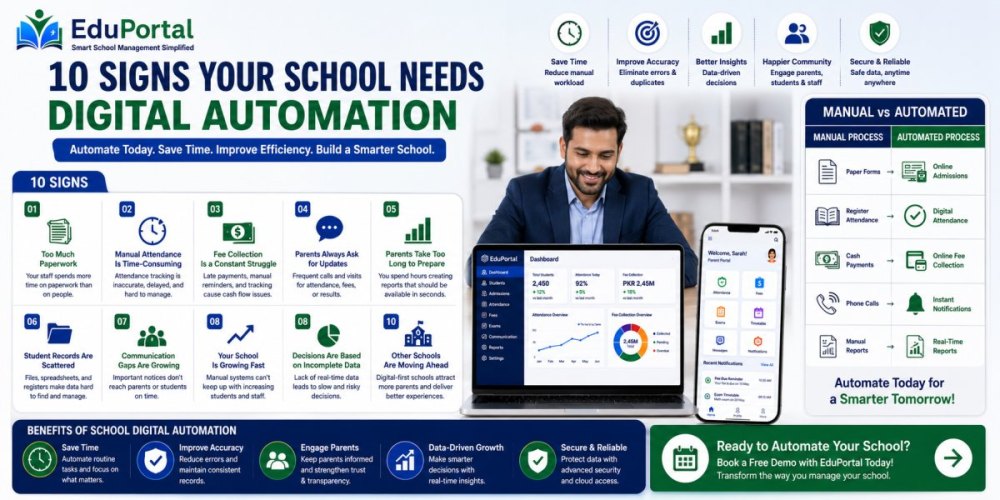
Manual School Operations vs Digital Automation
| Area | Manual Processes | School Digital Automation |
|---|---|---|
| Attendance | Paper Registers | Automated Tracking |
| Admissions | Physical Forms | Online Applications |
| Fee Collection | Manual Monitoring | Automated Management |
| Communication | Printed Notices | Real-Time Notifications |
| Reporting | Manual Compilation | Instant Reports |
| Student Records | Filing Cabinets | Centralized Database |
| Data Accuracy | Error-Prone | Highly Accurate |
| Accessibility | Limited | Anywhere Access |
The difference becomes more significant as schools grow.
10 Signs Your School Needs Digital Automation
1. Your Staff Spend Too Much Time on Administrative Tasks
If teachers and administrators spend hours on paperwork, data entry, and repetitive tasks, productivity suffers.
Common Examples
-
Manual attendance entry
-
Fee record updates
-
Report preparation
-
Student record management
Automation frees staff to focus on education rather than paperwork.
2. Attendance Tracking Is Becoming Difficult
Attendance is one of the most important school processes.
Manual attendance systems often lead to:
-
Delays
-
Errors
-
Incomplete records
A digital attendance system improves accuracy and visibility.
3. Fee Collection Is Frequently Delayed
Outstanding fees create financial challenges for schools.
Signs include:
-
Missed payments
-
Manual follow-ups
-
Difficult fee tracking
Automated fee management systems improve collection efficiency.
4. Parents Frequently Request Information
If your office receives constant inquiries about attendance, fees, schedules, or results, communication systems may be outdated.
Modern parent portals provide self-service access to information.
5. School Reports Take Too Long to Generate
Administrators need timely information.
If reports require extensive manual compilation, automation can dramatically improve efficiency.
Examples
-
Attendance reports
-
Financial reports
-
Examination analysis
-
Enrollment statistics
6. Student Records Are Difficult to Manage
Paper files and spreadsheets become difficult to maintain as enrollment grows.
Digital systems centralize student information and improve accessibility.
7. Communication Gaps Are Increasing
Parents expect timely updates.
Delayed communication often results in:
-
Frustration
-
Missed information
-
Reduced trust
Digital communication tools improve engagement and transparency.
8. Your School Is Growing Rapidly
Growth increases operational complexity.
Schools adding students, campuses, or programs often struggle with manual systems.
Automation supports scalability.
9. Decision-Making Relies on Incomplete Data
Without real-time information, leaders may struggle to identify:
-
Attendance trends
-
Academic performance issues
-
Financial challenges
Automation provides actionable insights.
10. Competitor Schools Are More Digitally Advanced
Parents increasingly compare schools based on technology and convenience.
Schools that lag behind may struggle to remain competitive.
Digital transformation is becoming a necessity rather than a differentiator.
Benefits of School Digital Automation
Increased Efficiency
Automate repetitive tasks and reduce workload.
Improved Accuracy
Reduce human errors through centralized systems.
Better Parent Engagement
Provide instant access to important information.
Enhanced Financial Management
Improve fee collection and reporting.
Real-Time Insights
Support better decision-making through analytics.
Greater Scalability
Manage growth without increasing administrative complexity.
Real School Scenario
A private school with 2,500 students experienced growing operational challenges.
Issues
-
Manual attendance tracking
-
Delayed fee collection
-
Slow reporting
-
Parent communication complaints
Solution
The school implemented a School ERP platform with automation tools.
Results
Within one academic year:
-
Administrative workload decreased significantly
-
Fee collection improved
-
Reporting became real-time
-
Parent engagement increased
-
School leadership gained better visibility into operations
The school successfully modernized its administration.
Common Mistakes Schools Make
Waiting Too Long to Automate
Delaying digital transformation often increases operational challenges.
Automating Only One Department
Schools achieve the greatest benefits through integrated automation.
Ignoring Staff Training
Successful implementation requires proper onboarding.
Choosing Software Based Solely on Cost
Long-term value is more important than initial pricing.
Overlooking Parent Experience
Automation should improve communication and accessibility.
Expert Recommendation
Small Schools
Begin with:
-
Attendance automation
-
Parent communication tools
-
Fee management
Medium-Sized Schools
Add:
-
Admissions management
-
Reporting dashboards
-
Examination modules
Large Educational Institutions
Implement:
-
Comprehensive School ERP systems
-
Multi-campus management
-
Advanced analytics
-
Cloud infrastructure
Schools should adopt automation gradually but strategically.
How EduPortal Solves This Problem
EduPortal is designed to help schools transition smoothly from manual processes to intelligent automation.
Admissions Automation
Digitize inquiries, applications, and enrollment workflows.
Attendance Management
Track attendance accurately and efficiently.
Smart Fee Management
Improve collection rates and financial visibility.
Parent Communication Tools
Keep families informed through mobile apps and notifications.
Reporting & Analytics
Generate real-time insights and performance reports.
Multi-Campus Support
Manage multiple branches from a centralized dashboard.
Cloud-Based Accessibility
Access school operations securely from anywhere.
Integrated School Management
Unify admissions, academics, finance, communication, and reporting into one platform.
EduPortal empowers schools to operate more efficiently while delivering better educational experiences.
Frequently Asked Questions
1. What is School Digital Automation?
School Digital Automation uses technology to automate administrative and academic processes.
2. Why do schools need automation?
Automation improves efficiency, accuracy, communication, and scalability.
3. What processes can schools automate?
Admissions, attendance, fees, examinations, communication, and reporting.
4. Can automation reduce administrative workload?
Yes. It eliminates repetitive manual tasks.
5. Is automation suitable for small schools?
Absolutely. Schools of all sizes benefit from automation.
6. How does automation improve fee collection?
Automated reminders and tracking improve payment compliance.
7. Can automation improve parent engagement?
Yes. Parents receive real-time updates and easier access to information.
8. How does automation support growth?
It enables schools to manage larger student populations efficiently.
9. What role does cloud technology play?
Cloud systems provide secure access from anywhere.
10. Can automation improve attendance management?
Yes. Digital tracking improves accuracy and reporting.
11. What are the risks of manual processes?
Errors, delays, inefficiencies, and limited scalability.
12. How long does digital transformation take?
Implementation timelines vary depending on school size and requirements.
13. What should schools automate first?
Attendance, communication, and fee management.
14. How does automation improve decision-making?
It provides real-time data and actionable insights.
15. Why choose EduPortal?
EduPortal offers complete School Digital Automation through a powerful, integrated School ERP platform.
Conclusion
The signs that a school needs digital automation are often visible long before operational problems become critical. Administrative overload, communication challenges, reporting delays, and inefficient fee management all indicate that traditional processes may no longer be sufficient.
By embracing School Digital Automation, educational institutions can improve efficiency, strengthen parent relationships, enhance decision-making, and create a stronger foundation for future growth.
Schools that act today will be better prepared to meet the expectations of tomorrow.
Ready to Automate Your School Operations?
Discover how EduPortal can help your institution streamline administration, improve communication, and embrace the future of education through smart digital automation.
Book your EduPortal demo today and start your school's digital transformation journey.