How Online Assessments Improve Student Learning Outcomes in 2026
Quick Answer
Online Assessments in Education help schools evaluate student knowledge, skills, and progress through digital platforms rather than traditional paper-based examinations. These assessments provide instant feedback, automated grading, real-time analytics, and personalized learning insights that help teachers identify strengths and learning gaps more effectively.
In 2026, online assessments have become a key component of modern education because they improve student engagement, enhance learning outcomes, reduce administrative workload, and support data-driven teaching strategies. Schools that implement online assessment systems often experience better academic performance, faster intervention opportunities, improved student participation, and more accurate performance tracking. When integrated with a Learning Management System (LMS) and School ERP, online assessments create a powerful framework for continuous improvement and academic excellence.
Introduction
Assessment is one of the most important aspects of education.
Schools use assessments to measure learning, evaluate academic progress, identify knowledge gaps, and guide instructional decisions.
For decades, educational institutions relied primarily on paper-based tests and examinations.
While traditional assessments still have value, they often present challenges such as:
-
Delayed feedback
-
Time-consuming grading
-
Limited performance insights
-
Administrative workload
-
Difficulty tracking learning progress
As schools embrace digital transformation, assessment methods are evolving.
Modern educational institutions increasingly use Online Assessments in Education to improve both teaching and learning outcomes.
Online assessments are not simply digital versions of traditional exams.
They provide powerful tools that help educators understand student performance, personalize instruction, and improve academic achievement.
For school owners, principals, and administrators, understanding how online assessments impact learning outcomes is essential for building a future-ready educational institution.
Why This Topic Matters in 2026
Several educational trends are accelerating the adoption of online assessments.
Increased Focus on Learning Outcomes
Schools are placing greater emphasis on measurable academic achievement.
Personalized Learning Growth
Students benefit from individualized learning pathways.
Data-Driven Education
Educational leaders increasingly rely on real-time academic insights.
LMS Adoption
Learning Management Systems make online assessments easier to implement.
Student Digital Readiness
Modern students are comfortable using technology for learning and evaluation.
These factors make online assessments a critical component of modern education.
What Are Online Assessments?
Online Assessments in Education are digital evaluation methods used to measure student knowledge, understanding, skills, and performance.
Assessments can be delivered through:
-
Learning Management Systems (LMS)
-
School ERP platforms
-
Online examination software
-
Educational apps
They can include:
Multiple Choice Questions
Fast and automatically graded.
Short Answer Questions
Assess conceptual understanding.
Essay-Based Responses
Evaluate critical thinking and communication.
Interactive Assessments
Include multimedia and simulation-based questions.
Adaptive Assessments
Adjust difficulty based on student performance.
Online assessments provide greater flexibility and insight than traditional methods.
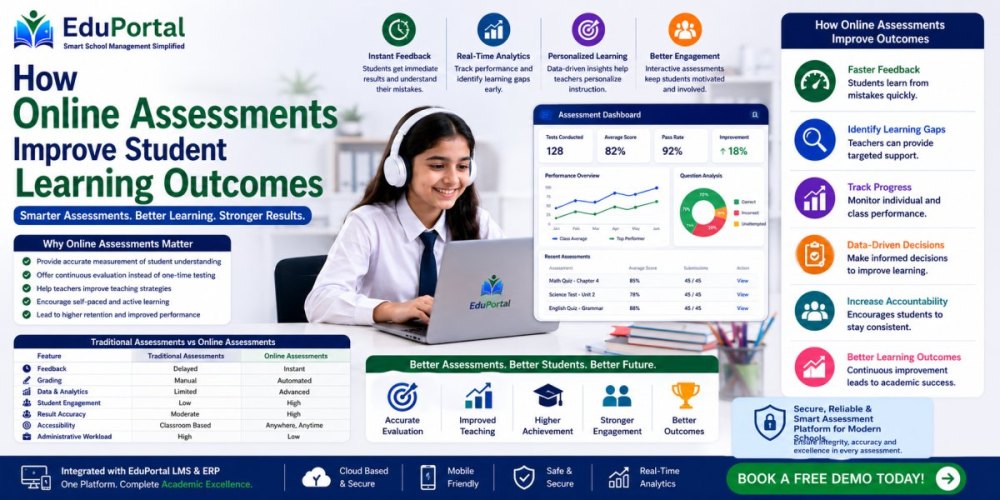
Traditional Assessments vs Online Assessments
| Feature | Traditional Assessments | Online Assessments |
|---|---|---|
| Grading | Manual | Automated |
| Feedback Speed | Delayed | Instant |
| Reporting | Limited | Real-Time |
| Data Analysis | Difficult | Advanced |
| Accessibility | Classroom-Based | Anywhere |
| Student Engagement | Moderate | High |
| Personalization | Limited | Strong |
| Administrative Workload | High | Low |
The differences significantly impact educational effectiveness.
How Online Assessments Improve Student Learning Outcomes
Instant Feedback Accelerates Learning
One of the biggest advantages of online assessments is immediate feedback.
Students can quickly understand:
-
Correct answers
-
Mistakes
-
Areas for improvement
This creates a continuous learning cycle.
Result
Students learn faster and retain information more effectively.
Early Identification of Learning Gaps
Traditional exams often reveal problems too late.
Online assessments provide continuous performance data.
Teachers can identify:
-
Weak concepts
-
Struggling students
-
Subject-specific challenges
Earlier intervention improves outcomes.
Increased Student Engagement
Digital assessments often include:
-
Interactive questions
-
Multimedia content
-
Gamified elements
These features make assessments more engaging.
Engaged students tend to perform better academically.
Personalized Learning Opportunities
Online assessments generate detailed performance data.
Teachers can use this information to customize instruction.
Examples
-
Additional practice
-
Remedial support
-
Advanced learning activities
Personalized learning improves academic success.
Continuous Assessment Model
Instead of relying only on final examinations, schools can assess learning continuously.
Benefits
-
Reduced exam pressure
-
Better performance monitoring
-
Consistent improvement
Students receive ongoing support throughout the academic year.
Better Retention and Knowledge Reinforcement
Frequent online quizzes reinforce learning.
Students review concepts more regularly.
This strengthens long-term retention.
Improved Student Accountability
Students can track their own progress.
Self-awareness encourages responsibility and motivation.
Data-Driven Teaching Strategies
Teachers gain valuable insights into classroom performance.
Instruction becomes more targeted and effective.
Benefits of Online Assessments for Schools
Faster Academic Reporting
Administrators gain instant access to performance data.
Reduced Administrative Workload
Automation reduces grading and reporting tasks.
Improved Educational Quality
Better assessment data supports stronger teaching practices.
Greater Scalability
Online assessments can support large student populations efficiently.
Enhanced Parent Visibility
Parents can access academic progress more easily.
Real School Scenario
A secondary school with 3,200 students relied on traditional examinations.
Challenges
-
Delayed grading
-
Limited academic insights
-
High teacher workload
-
Difficulty identifying struggling students
Solution
The school implemented online assessments through its LMS platform.
Results After One Academic Year
-
Student engagement increased
-
Teacher workload decreased
-
Learning gaps were identified earlier
-
Academic performance improved
-
Parent involvement increased
The school achieved measurable improvements in learning outcomes.
Types of Online Assessments Schools Can Use
Formative Assessments
Used during learning.
Purpose:
-
Monitor progress
-
Provide feedback
Summative Assessments
Used at the end of units or terms.
Purpose:
-
Evaluate achievement
Diagnostic Assessments
Identify strengths and weaknesses.
Adaptive Assessments
Adjust difficulty levels automatically.
Practice Assessments
Help students prepare for examinations.
Key Features to Look for in an Online Assessment Platform
Automated Grading
Reduce teacher workload.
Real-Time Analytics
Provide actionable insights.
Question Banks
Support efficient assessment creation.
LMS Integration
Connect assessments with learning activities.
Mobile Accessibility
Enable flexible participation.
Security Features
Protect academic integrity.
Parent Access
Improve transparency and engagement.
Common Mistakes Schools Make
Using Online Assessments Only for Exams
Continuous assessment creates greater value.
Ignoring Assessment Data
Insights should guide instructional decisions.
Focusing Only on Grades
Assessment should support learning improvement.
Failing to Train Teachers
Effective implementation requires professional development.
Choosing Platforms Without LMS Integration
Integrated systems provide better outcomes.
Expert Recommendation
Small Schools
Start with:
-
Online quizzes
-
Assignment assessments
-
Progress tracking
Medium Schools
Add:
-
Analytics dashboards
-
Formative assessments
-
Parent reporting
Large Educational Institutions
Implement:
-
Full LMS integration
-
Adaptive assessments
-
Advanced performance analytics
-
Multi-campus assessment management
Schools achieve the greatest success when online assessments become part of a broader digital learning strategy.
How EduPortal Solves This Problem
EduPortal provides comprehensive Online Assessment capabilities through its integrated LMS and School ERP platform.
Digital Examination Management
Conduct assessments efficiently online.
Automated Grading
Reduce manual workload and speed up evaluation.
Real-Time Performance Tracking
Monitor student progress instantly.
Learning Analytics
Identify trends and intervention opportunities.
Parent Engagement Tools
Keep families informed about academic performance.
Mobile Accessibility
Support assessments from any device.
LMS Integration
Connect assessments directly with courses, assignments, and learning resources.
Multi-Campus Support
Manage assessments across multiple branches.
EduPortal helps schools create data-driven learning environments that improve educational outcomes.
Frequently Asked Questions
1. What are Online Assessments in Education?
Digital tools used to evaluate student learning and academic performance.
2. How do online assessments improve learning outcomes?
They provide faster feedback, better insights, and personalized learning support.
3. Can online assessments improve student engagement?
Yes. Interactive assessments increase participation and motivation.
4. Are online assessments suitable for schools?
Absolutely. Schools of all sizes can benefit.
5. What is the biggest advantage of online assessments?
Immediate feedback and real-time analytics.
6. Can teachers automate grading?
Yes. Many assessments can be graded automatically.
7. How do online assessments support personalized learning?
They identify individual strengths and weaknesses.
8. Can parents access assessment results?
Most modern platforms provide parent visibility.
9. Are online assessments secure?
Yes. Modern platforms include security and monitoring features.
10. Can assessments be conducted through mobile devices?
Yes. Mobile accessibility is widely supported.
11. What is formative assessment?
Assessment used during learning to guide improvement.
12. What is adaptive assessment?
Assessment that adjusts difficulty levels based on performance.
13. Can online assessments integrate with LMS platforms?
Yes. Integration improves learning management.
14. How do online assessments reduce teacher workload?
Automation simplifies grading, reporting, and analysis.
15. Why choose EduPortal?
EduPortal combines LMS, assessments, analytics, reporting, and School ERP capabilities in one integrated platform.
Conclusion
The role of Online Assessments in Education extends far beyond testing.
Modern assessment systems help schools improve learning outcomes by providing faster feedback, stronger engagement, better performance insights, and personalized learning opportunities.
As education becomes increasingly data-driven and technology-enabled, online assessments are becoming essential tools for academic excellence.
Schools that embrace online assessment strategies today will be better positioned to support student success, improve teaching effectiveness, and build future-ready learning environments.
Ready to Improve Student Learning Outcomes?
Discover how EduPortal can help your institution implement powerful online assessments, learning analytics, and LMS solutions that drive academic success.
Book an EduPortal demo today and transform the way your school evaluates learning.