Top Benefits of LMS for Schools and Colleges in 2026
Quick Answer
The Benefits of LMS for Schools and Colleges extend far beyond online learning. A Learning Management System (LMS) helps educational institutions manage courses, assignments, assessments, communication, and student progress through a centralized digital platform. It improves teaching efficiency, enhances student engagement, supports personalized learning, increases parent involvement, and provides valuable academic insights through real-time reporting and analytics.
In 2026, schools and colleges are increasingly adopting LMS platforms as part of their digital transformation strategies. Educational institutions that implement an LMS often experience improved academic performance, streamlined administration, better collaboration, reduced paperwork, and stronger learning outcomes. When integrated with a School ERP system, an LMS creates a complete digital ecosystem that supports both educational excellence and operational efficiency.
Introduction
Education is rapidly evolving.
Traditional teaching methods alone are no longer sufficient to meet the expectations of modern students, parents, and educational institutions.
Today's learners expect:
-
Flexible learning
-
Digital resources
-
Interactive content
-
Instant feedback
-
Mobile accessibility
At the same time, teachers and administrators face growing responsibilities.
They must manage:
-
Assignments
-
Assessments
-
Student progress
-
Communication
-
Academic reporting
While maintaining high educational standards.
This is where Learning Management Systems (LMS) have become essential.
A Learning Management System provides schools and colleges with the tools needed to manage teaching and learning more effectively.
For educational leaders, understanding the benefits of LMS technology is critical for building future-ready institutions.
Why This Topic Matters in 2026
Several educational trends are driving LMS adoption worldwide.
Blended Learning Is Becoming Standard
Schools increasingly combine classroom instruction with digital learning.
Student Expectations Are Changing
Modern learners expect technology-enabled education.
Greater Focus on Personalized Learning
Institutions are moving away from one-size-fits-all teaching approaches.
Data-Driven Decision Making
Educational leaders rely on analytics to improve outcomes.
Digital Transformation Initiatives
Schools and colleges are investing heavily in educational technology.
These trends make LMS adoption a strategic priority.
What Is a Learning Management System (LMS)?
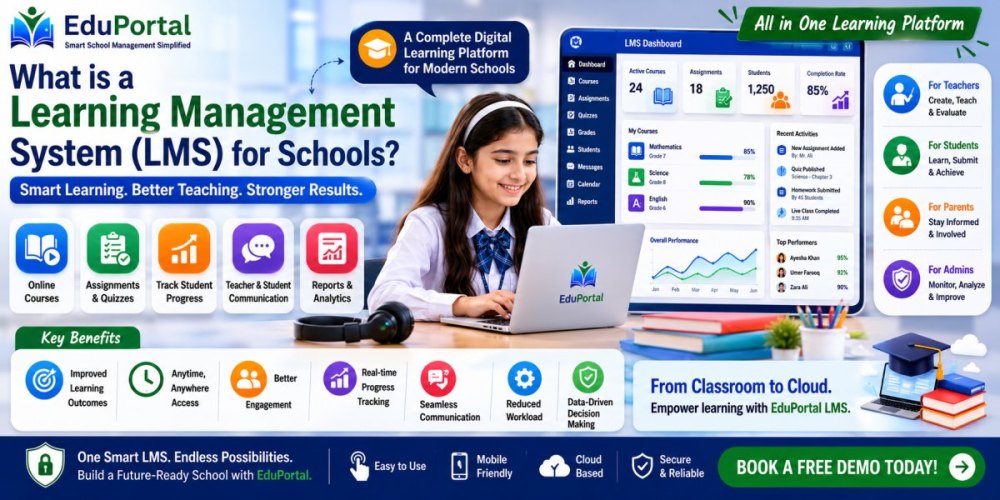
A Learning Management System is a software platform that enables institutions to create, manage, deliver, and track educational content and learning activities.
An LMS serves as a centralized digital learning environment where:
Teachers Can
-
Upload lessons
-
Create assignments
-
Conduct assessments
-
Track progress
Students Can
-
Access learning resources
-
Submit assignments
-
Take quizzes
-
View feedback
Parents Can
-
Monitor academic performance
-
Track assignments
-
Stay informed
Administrators Can
-
Analyze learning outcomes
-
Generate reports
-
Manage academic operations
The LMS becomes the foundation of digital education.
Traditional Learning vs LMS-Based Learning
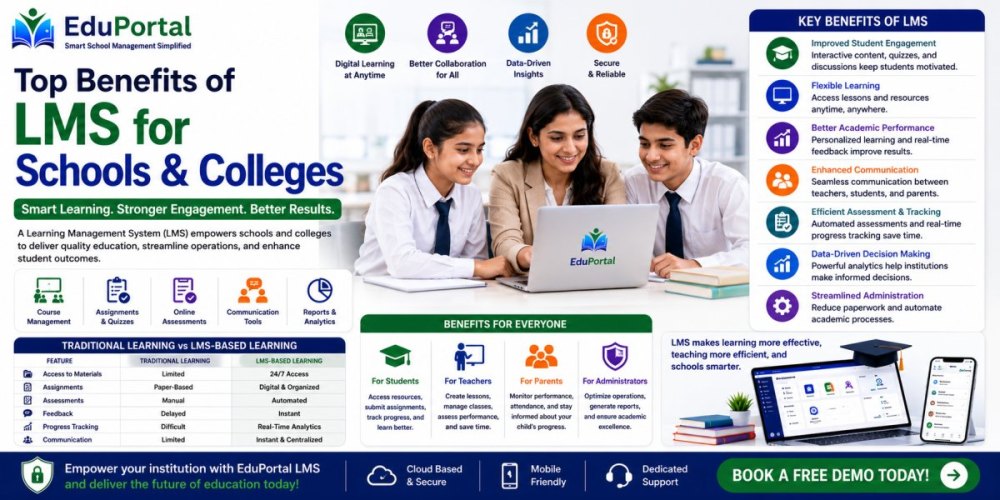
| Feature | Traditional Learning | LMS-Based Learning |
|---|---|---|
| Learning Materials | Classroom Only | Anytime Access |
| Assignments | Paper-Based | Digital |
| Assessments | Manual | Automated |
| Progress Tracking | Limited | Real-Time |
| Communication | Delayed | Instant |
| Analytics | Basic | Advanced |
| Flexibility | Low | High |
| Parent Visibility | Limited | Enhanced |
The LMS enhances educational experiences across all stakeholders.
Top Benefits of LMS for Schools and Colleges
Improved Student Engagement
Student engagement is one of the most significant benefits of LMS implementation.
Interactive learning tools increase participation and motivation.
Features That Improve Engagement
-
Multimedia content
-
Interactive quizzes
-
Gamification
-
Discussion forums
-
Instant feedback
Engaged students are more likely to succeed academically.
Anytime, Anywhere Learning
Students are no longer restricted to classroom walls.
An LMS provides access to learning materials from:
-
Home
-
School
-
Mobile devices
-
Remote locations
This flexibility supports modern learning habits.
Better Academic Performance Tracking
Educational leaders gain access to real-time performance data.
Schools can monitor:
-
Grades
-
Assignment completion
-
Attendance
-
Learning progress
This enables early intervention when needed.
Enhanced Teaching Efficiency
Teachers spend less time on administrative tasks and more time teaching.
LMS Automation Includes
-
Assignment distribution
-
Grading
-
Progress tracking
-
Reporting
Efficiency improves significantly.
Personalized Learning Experiences
Every student learns differently.
An LMS helps educators adapt instruction to individual learning needs.
Benefits
-
Customized learning paths
-
Targeted support
-
Improved outcomes
Improved Communication
Communication becomes easier between:
-
Teachers
-
Students
-
Parents
-
Administrators
Real-time communication strengthens educational collaboration.
Better Parent Engagement
Parents gain greater visibility into student performance.
They can access:
-
Grades
-
Assignments
-
Attendance
-
Progress reports
This improves parent-school partnerships.
Reduced Paperwork
Digital systems replace:
-
Printed assignments
-
Physical reports
-
Paper records
Schools save time and resources.
Real-Time Reporting & Analytics
Administrators gain valuable insights into academic performance.
Reports can include:
-
Student achievement
-
Teacher performance
-
Course effectiveness
-
Learning trends
Data-driven decisions become easier.
Scalability for Growing Institutions
LMS platforms support growth without increasing administrative complexity.
Improved Assessment Management
Online assessments simplify testing and evaluation.
Benefits include:
-
Automated grading
-
Faster feedback
-
Reduced workload
Stronger Digital Skills Development
Students develop important technology skills needed for future careers.
Real School Scenario
A college with 5,000 students faced challenges managing assignments, communication, and academic reporting.
Challenges
-
Delayed feedback
-
Limited learning flexibility
-
High administrative workload
-
Low parent visibility
Solution
The institution implemented a Learning Management System integrated with its School ERP platform.
Results Within One Academic Year
-
Student engagement increased significantly
-
Assignment completion rates improved
-
Teacher productivity increased
-
Parent participation improved
-
Academic reporting became more efficient
The LMS became a central component of the institution's digital transformation strategy.
LMS Benefits for Different Stakeholders
Benefits for Students
-
Flexible learning
-
Better engagement
-
Faster feedback
-
Personalized support
Benefits for Teachers
-
Reduced workload
-
Easier assessment management
-
Better student insights
Benefits for Parents
-
Greater visibility
-
Improved communication
-
Better progress monitoring
Benefits for Administrators
-
Centralized management
-
Data-driven decision making
-
Improved efficiency
Common Mistakes Schools Make
Choosing LMS Based Only on Cost
Functionality and scalability should be prioritized.
Ignoring Teacher Training
User adoption is critical.
Not Defining Clear Goals
Schools should establish objectives before implementation.
Failing to Integrate with School ERP
Disconnected systems reduce efficiency.
Neglecting Parent Involvement
Parent participation strengthens LMS effectiveness.
Expert Recommendation
Small Schools
Start with:
-
Assignment management
-
Communication tools
-
Learning content delivery
Medium Schools
Add:
-
Online assessments
-
Analytics
-
Parent portals
Large Educational Institutions
Implement:
-
Full LMS integration
-
Personalized learning
-
Advanced reporting
-
Multi-campus management
The greatest success comes when LMS adoption aligns with broader educational goals.
How EduPortal Solves This Problem
EduPortal provides a complete Learning Management System designed specifically for schools and colleges.
Course & Content Management
Deliver digital learning efficiently.
Assignment & Assessment Tools
Simplify evaluation processes.
Student Progress Tracking
Monitor performance in real time.
Parent Engagement Features
Keep families informed and involved.
Mobile Accessibility
Support learning anywhere.
Analytics & Reporting
Generate actionable academic insights.
School ERP Integration
Connect LMS functionality with admissions, attendance, fees, communication, and examinations.
Multi-Campus Support
Manage learning across multiple locations.
EduPortal helps institutions create smarter, more connected learning environments.
Frequently Asked Questions
1. What is an LMS?
A Learning Management System is a digital platform used to manage teaching and learning activities.
2. Why do schools need an LMS?
To improve learning delivery, engagement, and academic management.
3. Can LMS improve student performance?
Yes. It supports better engagement and progress monitoring.
4. Is LMS useful for colleges?
Absolutely. Colleges benefit from scalability and flexibility.
5. Can parents access LMS platforms?
Most modern LMS solutions include parent access.
6. Does LMS support mobile learning?
Yes. Mobile accessibility is a key feature.
7. How does LMS help teachers?
It automates many administrative and academic tasks.
8. Can LMS reduce paperwork?
Yes. Digital processes replace many paper-based activities.
9. Does LMS support online assessments?
Yes. Online testing is a core feature.
10. Can LMS integrate with School ERP software?
Yes. Integration improves efficiency and data consistency.
11. What is blended learning?
A combination of classroom teaching and digital learning.
12. Can LMS support personalized learning?
Yes. Learning paths can be customized.
13. Is LMS suitable for small schools?
Yes. Schools of all sizes can benefit.
14. How long does implementation take?
Implementation varies depending on institution size and requirements.
15. Why choose EduPortal?
EduPortal combines LMS functionality and School ERP capabilities within one integrated platform.
Conclusion
The Benefits of LMS for Schools and Colleges extend across every aspect of education. From improving student engagement and academic performance to simplifying administration and strengthening parent involvement, an LMS helps institutions create more effective and future-ready learning environments.
As digital transformation continues to reshape education in 2026, schools and colleges that invest in LMS technology will be better positioned to deliver exceptional learning experiences while improving operational efficiency.
The future of education is connected, flexible, data-driven, and digital.
Ready to Transform Learning?
Discover how EduPortal can help your institution implement a powerful Learning Management System integrated with complete School ERP functionality.
Book an EduPortal demo today and build a smarter learning environment for students, teachers, and parents.