AI in Education: How Artificial Intelligence is Transforming Schools in 2026
Quick Answer
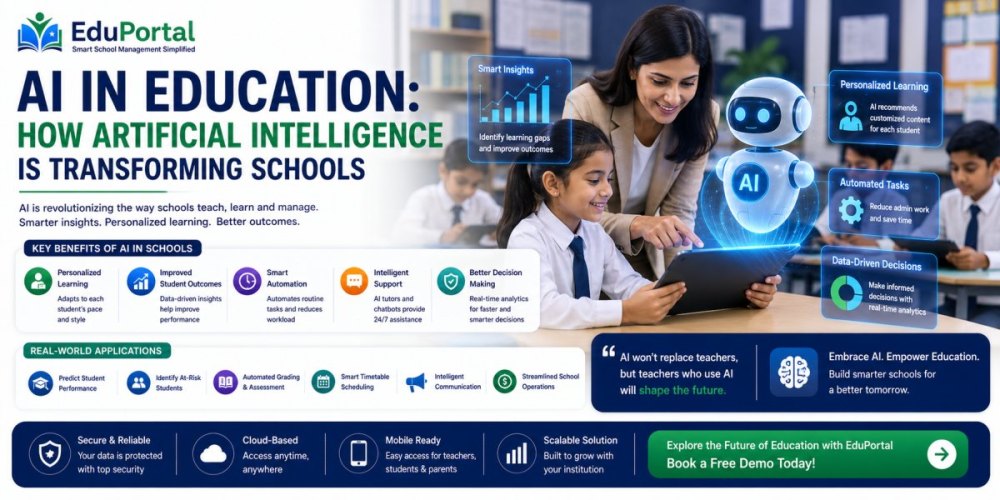
AI in Education refers to the use of Artificial Intelligence technologies to improve teaching, learning, administration, communication, and decision-making within educational institutions. Modern schools are using AI to automate routine tasks, personalize student learning experiences, improve attendance tracking, enhance parent communication, predict student performance, and optimize administrative operations.
In 2026, AI is no longer a futuristic concept—it is becoming an essential part of modern education. Schools that embrace AI can reduce administrative workload, improve efficiency, make data-driven decisions, and deliver better educational experiences for students, teachers, and parents. Rather than replacing educators, AI empowers them by automating repetitive tasks and providing valuable insights that support student success and institutional growth.
Introduction
Education is experiencing one of the most significant technological transformations in its history.
For decades, schools relied on traditional teaching methods, paper-based administration, and manual processes to manage operations. While technology gradually improved educational management, the emergence of Artificial Intelligence has accelerated change at an unprecedented pace.
Today, AI is influencing nearly every aspect of school operations—from attendance tracking and admissions management to personalized learning and predictive analytics.
For school owners, principals, and administrators, the question is no longer whether AI will impact education.
The real question is:
How can schools use AI strategically to improve learning outcomes, operational efficiency, and institutional growth?
The schools that successfully integrate AI into their operations will be better equipped to meet rising parent expectations, support teachers, improve student performance, and remain competitive in an increasingly digital world.
This guide explores how AI is transforming education in 2026, the opportunities it presents, and how schools can implement AI effectively.
Why AI in Education Matters in 2026
Artificial Intelligence has moved beyond experimentation.
It is now becoming a practical tool for solving real educational challenges.
Growing Administrative Complexity
Schools are managing larger student populations, more data, and increasing compliance requirements.
AI helps automate many routine administrative tasks.
Demand for Personalized Learning
Every student learns differently.
AI enables schools to create customized learning experiences based on individual needs.
Increased Parent Expectations
Parents expect real-time communication, transparency, and digital access to school information.
Data-Driven Decision Making
School leaders need actionable insights rather than raw data.
AI transforms data into meaningful recommendations.
Teacher Workload Challenges
Teachers face increasing administrative responsibilities.
AI helps reduce repetitive work and allows educators to focus on teaching.
What Is AI in Education?
AI in Education refers to the use of machine learning, data analytics, natural language processing, automation, and intelligent systems to improve educational processes.
The goal is not to replace teachers.
Instead, AI supports educators by improving efficiency and providing insights that help students succeed.
Common Applications of AI in Schools
-
Personalized learning
-
Attendance monitoring
-
Academic performance prediction
-
Student support systems
-
Automated grading
-
Administrative automation
-
Parent communication
-
Admissions management
-
Reporting and analytics
As AI technology continues to mature, its role in education will become increasingly important.
Traditional School Operations vs AI-Powered Schools
| Function | Traditional Approach | AI-Powered Approach |
|---|---|---|
| Attendance Tracking | Manual Registers | Automated Monitoring |
| Parent Communication | Reactive | Real-Time & Automated |
| Academic Support | One-Size-Fits-All | Personalized Learning |
| Reporting | Manual Analysis | Predictive Insights |
| Student Performance Monitoring | Periodic Reviews | Continuous Tracking |
| Administrative Tasks | Labor Intensive | Automated Workflows |
| Decision Making | Historical Data | Real-Time Intelligence |
| Resource Planning | Estimates | AI-Driven Forecasting |
Schools that leverage AI gain a significant operational and strategic advantage.
Key Ways AI Is Transforming Schools
Personalized Learning Experiences
One of the most impactful applications of AI in Education is personalized learning.
Traditional classrooms often deliver the same content to all students regardless of learning style or pace.
AI helps identify:
-
Learning strengths
-
Knowledge gaps
-
Progress patterns
-
Preferred learning methods
Example
An AI-powered learning platform can recommend additional exercises for students struggling with mathematics while providing advanced materials to high-performing learners.
Smarter Attendance Management
Attendance data contains valuable insights.
AI can analyze attendance patterns and identify:
-
Frequent absenteeism
-
Attendance risks
-
Behavioral concerns
Benefits
-
Early intervention
-
Improved accountability
-
Better student support
Predictive Academic Analytics
AI enables schools to identify students who may be at risk academically.
By analyzing:
-
Attendance records
-
Assessment results
-
Participation data
AI can predict performance trends before serious issues arise.
This allows schools to provide support proactively rather than reactively.
Automated Administrative Tasks
School administrators spend significant time on repetitive tasks.
AI can automate:
-
Data entry
-
Report generation
-
Admissions processing
-
Communication workflows
-
Scheduling
This improves efficiency and reduces operational costs.
Intelligent Parent Communication
Communication is critical for school success.
AI-powered systems can automatically:
-
Send attendance notifications
-
Share academic updates
-
Deliver fee reminders
-
Provide personalized alerts
Parents remain informed without increasing staff workload.
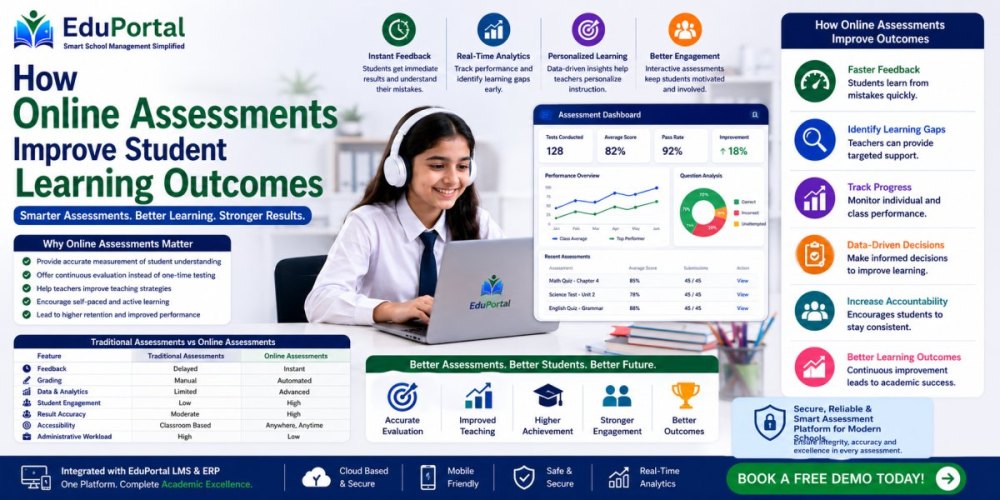
Enhanced Examination Management
AI can assist with:
-
Exam scheduling
-
Performance analysis
-
Result reporting
-
Assessment insights
This helps schools gain a deeper understanding of student performance.
Virtual Learning Assistants
AI-powered chatbots and assistants can answer common questions from:
-
Students
-
Parents
-
Teachers
Examples include:
-
Timetable inquiries
-
Fee information
-
Attendance status
-
Assignment deadlines
This improves service quality while reducing administrative burden.
Smarter Resource Planning
AI helps schools forecast future needs by analyzing trends.
Examples
-
Enrollment projections
-
Staff requirements
-
Classroom utilization
-
Financial planning
This supports long-term institutional growth.
Real School Scenario
A private school with approximately 3,000 students was facing several challenges.
Problems
-
High administrative workload
-
Delayed reporting
-
Attendance monitoring difficulties
-
Limited visibility into student performance
Solution
The school implemented AI-powered educational management tools integrated with its School ERP.
Results After One Academic Year
-
Administrative efficiency improved significantly
-
Attendance intervention became more proactive
-
Parent communication became faster and more personalized
-
Academic risk identification improved
-
Leadership gained access to predictive insights
The school reported improved operational efficiency and better decision-making across departments.
Benefits of AI in Education for School Leaders
Improved Operational Efficiency
AI automates routine administrative processes.
Better Decision Making
Leaders gain access to actionable insights rather than raw data.
Enhanced Student Success
Personalized learning and predictive analytics improve outcomes.
Stronger Parent Engagement
AI-powered communication improves transparency.
Reduced Administrative Costs
Automation reduces manual effort and operational inefficiencies.
Greater Scalability
Schools can manage growth more effectively using intelligent systems.
Common Mistakes Schools Make
Viewing AI as a Replacement for Teachers
AI should support educators, not replace them.
Human interaction remains essential.
Implementing AI Without Clear Objectives
Schools should define specific goals before adopting AI technologies.
Ignoring Staff Training
Successful implementation requires teacher and staff readiness.
Focusing Only on Academic Applications
AI can improve administration, communication, finance, and operations as well.
Neglecting Data Security
Schools must prioritize privacy and data protection when implementing AI systems.
Expert Recommendation
Small Schools
Focus on:
-
AI-powered communication
-
Attendance analytics
-
Administrative automation
Medium-Sized Schools
Add:
-
Predictive reporting
-
Personalized learning tools
-
Intelligent dashboards
Large Educational Networks
Prioritize:
-
Advanced analytics
-
Multi-campus AI insights
-
Strategic forecasting
-
Enterprise-level automation
The most successful schools implement AI gradually while maintaining strong human oversight.
How EduPortal Solves This Problem
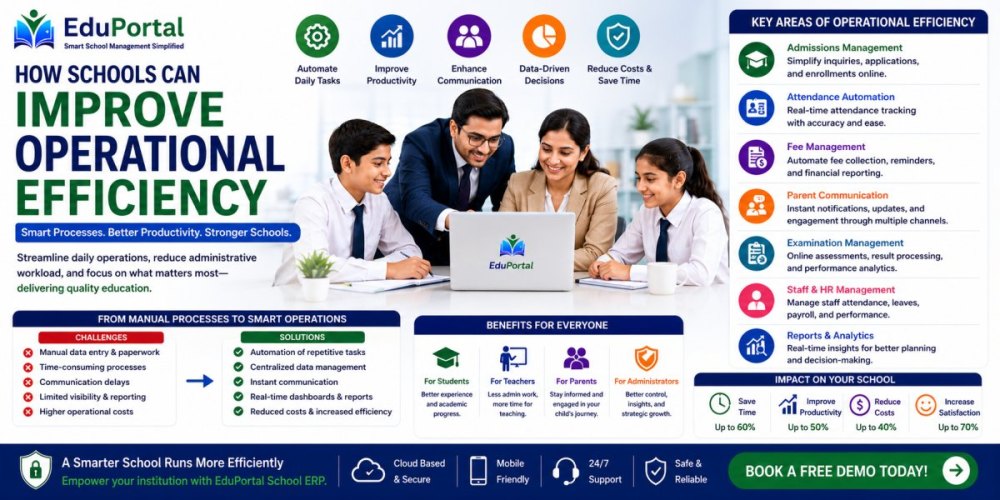
EduPortal helps schools embrace digital transformation through intelligent automation and data-driven management tools.
Smart Attendance Tracking
Monitor attendance and identify trends efficiently.
Automated Communication
Improve parent engagement through real-time notifications.
Advanced Reporting & Analytics
Transform operational data into actionable insights.
Student Performance Monitoring
Track academic progress and support intervention strategies.
Fee Management Automation
Reduce manual financial processes.
Cloud-Based School Management
Access information securely from anywhere.
Centralized School Operations
Manage admissions, attendance, communication, examinations, and reporting from a single platform.
By combining automation, analytics, and modern school management capabilities, EduPortal helps schools prepare for the future of education.
Frequently Asked Questions
1. What is AI in Education?
AI in Education refers to using Artificial Intelligence technologies to improve learning, administration, communication, and decision-making in schools.
2. How does AI improve education?
AI automates tasks, personalizes learning, improves analytics, and enhances operational efficiency.
3. Can AI replace teachers?
No. AI supports teachers by reducing administrative work and providing insights.
4. How is AI used in schools today?
Schools use AI for attendance tracking, communication, learning platforms, reporting, and predictive analytics.
5. What are the benefits of AI in Education?
Improved efficiency, personalized learning, better communication, and data-driven decision-making.
6. Is AI expensive for schools?
Many AI-powered solutions are scalable and affordable for schools of various sizes.
7. Can AI improve student performance?
Yes. AI helps identify learning gaps and supports personalized interventions.
8. How does AI help administrators?
AI automates repetitive tasks and generates valuable insights.
9. Is AI safe for educational institutions?
When implemented correctly with proper security controls, AI can be highly secure.
10. Can small schools benefit from AI?
Absolutely. Small schools can improve efficiency through intelligent automation.
11. What role does AI play in attendance management?
AI identifies attendance patterns and supports proactive intervention.
12. How does AI improve parent communication?
Automated notifications and personalized updates improve engagement.
13. Can AI support school growth?
Yes. AI provides forecasting and planning insights that support expansion.
14. What are the biggest challenges of AI adoption?
Training, change management, and data governance.
15. Why should schools choose EduPortal?
EduPortal provides intelligent school management tools that help schools improve efficiency, communication, and decision-making.
Conclusion
Artificial Intelligence is reshaping education in ways that were unimaginable just a few years ago. From personalized learning and predictive analytics to automated administration and smarter communication, AI is helping schools become more efficient, responsive, and student-focused.
For school owners, principals, and administrators, the opportunity is clear. Institutions that embrace AI strategically can improve educational outcomes, reduce operational burdens, strengthen parent engagement, and make better decisions based on real-time insights.
The future of education is not about replacing people with technology—it is about empowering educators with smarter tools that help them succeed.
Ready to Transform Your School?
Discover how EduPortal can help your institution leverage intelligent automation, streamline operations, and prepare for the future of education.
Book an EduPortal demo today and explore how technology can help your school thrive in 2026 and beyond.