Biometric Attendance Systems for Schools: Complete Guide (2026)
Quick Answer
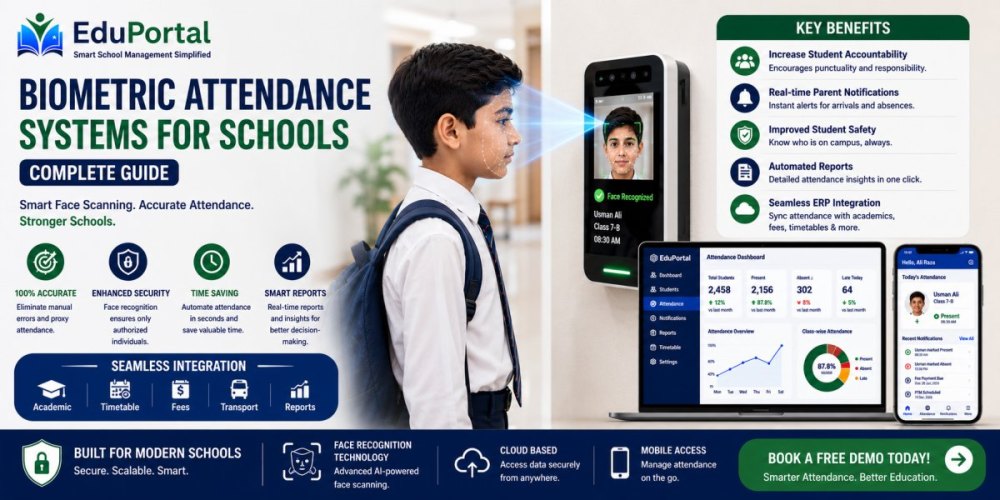
A Biometric Attendance System for Schools uses fingerprint, facial recognition, iris scanning, or other biometric technologies to accurately record student and staff attendance. Unlike traditional attendance registers or manual entry systems, biometric attendance automates attendance tracking, reduces errors, prevents proxy attendance, and provides real-time attendance data.
In 2026, schools are increasingly adopting biometric attendance systems as part of their digital transformation strategies. These systems improve operational efficiency, enhance student safety, strengthen parent communication, and provide school administrators with accurate attendance records and reporting. When integrated with a School ERP platform, biometric attendance systems become a powerful tool for improving school management and accountability.
Introduction
Attendance is one of the most important indicators of student engagement and academic success.
Schools depend on accurate attendance records to monitor participation, identify absenteeism patterns, communicate with parents, and meet regulatory requirements.
For many years, attendance was recorded manually using classroom registers.
While familiar, manual attendance systems present several challenges:
-
Human errors
-
Time-consuming processes
-
Delayed reporting
-
Proxy attendance
-
Limited real-time visibility
As educational institutions continue embracing digital transformation, attendance management is evolving rapidly.
One of the most effective solutions available today is the Biometric Attendance System for Schools.
Biometric technology enables schools to automate attendance tracking while improving accuracy, transparency, and security.
For school owners, principals, and administrators, understanding biometric attendance systems is becoming increasingly important.
This guide explains everything educational leaders need to know about biometric attendance systems in 2026.
Why This Topic Matters in 2026
Several trends are driving adoption of biometric attendance systems.
Increased Focus on Student Safety
Schools require accurate information about student presence and movement.
Biometric systems provide reliable attendance records.
Growing Student Populations
Managing attendance manually becomes difficult as enrollment increases.
Demand for Real-Time Information
Parents expect instant attendance notifications.
School Automation Initiatives
Attendance management is often one of the first processes schools automate.
Data-Driven School Management
Accurate attendance data supports better decision-making.
These factors make biometric attendance increasingly valuable for modern schools.
What Is a Biometric Attendance System?
A biometric attendance system uses unique biological characteristics to identify individuals and record attendance automatically.
Common biometric technologies include:
Fingerprint Recognition
Uses fingerprint patterns for identification.
Facial Recognition
Uses facial features to verify identity.
Iris Recognition
Uses unique iris patterns for authentication.
Palm Recognition
Uses palm characteristics for attendance tracking.
The system records attendance automatically when a student's biometric information is verified.
Traditional Attendance vs Biometric Attendance
| Feature | Manual Attendance | Biometric Attendance |
|---|---|---|
| Accuracy | Moderate | High |
| Attendance Time | Slow | Fast |
| Human Errors | Common | Minimal |
| Proxy Attendance | Possible | Eliminated |
| Reporting | Manual | Automated |
| Parent Notifications | Delayed | Real-Time |
| Data Analysis | Limited | Advanced |
| Scalability | Limited | Excellent |
The advantages become more apparent as schools grow.
How a Biometric Attendance System Works
Step 1: Enrollment
Students and staff register their biometric information.
Examples include:
-
Fingerprints
-
Facial scans
-
Iris scans
Step 2: Verification
The system verifies identity during entry or attendance marking.
Step 3: Attendance Recording
Attendance is recorded automatically.
Step 4: Data Synchronization
Information is transferred to the School ERP system.
Step 5: Notifications and Reporting
Schools can generate reports and notify parents instantly.
Benefits of Biometric Attendance Systems for Schools
Improved Accuracy
Manual attendance often contains errors.
Biometric verification ensures accurate records.
Elimination of Proxy Attendance
Students cannot mark attendance for others.
This improves accountability.
Time Savings
Attendance recording becomes significantly faster.
Teachers spend less time on administrative tasks.
Real-Time Attendance Monitoring
Administrators gain immediate visibility into attendance status.
Better Parent Communication
Parents receive instant attendance updates.
This strengthens engagement and transparency.
Improved Student Safety
Schools know who is present on campus at any given time.
Advanced Reporting
Administrators can analyze:
-
Attendance trends
-
Chronic absenteeism
-
Class attendance patterns
-
School-wide performance
Seamless School Automation
Biometric attendance integrates with broader school management systems.
Types of Biometric Attendance Systems
Fingerprint Attendance Systems
The most widely adopted solution.
Advantages
-
Affordable
-
Accurate
-
Easy to implement
Facial Recognition Systems
Increasingly popular in modern schools.
Advantages
-
Contactless operation
-
Fast identification
-
Enhanced convenience
Iris Recognition Systems
Highly secure and accurate.
Advantages
-
Advanced authentication
-
Difficult to duplicate
Hybrid Biometric Systems
Combine multiple biometric technologies.
Advantages
-
Maximum security
-
Greater flexibility
Real School Scenario
A private school with 3,500 students relied on manual attendance registers.
Challenges
-
Attendance errors
-
Delayed reporting
-
Parent complaints
-
Administrative workload
Solution
The school implemented a biometric attendance system integrated with its School ERP platform.
Results After One Academic Year
-
Attendance accuracy improved significantly
-
Administrative workload decreased
-
Parent communication improved
-
Real-time attendance reporting became available
-
Student accountability increased
The school successfully modernized its attendance management process.
Key Features to Look for in a Biometric Attendance System
Real-Time Synchronization
Attendance data should update instantly.
School ERP Integration
Attendance should connect with student records and reporting.
Parent Notifications
Automatic alerts improve transparency.
Mobile Accessibility
Administrators should access attendance data remotely.
Reporting & Analytics
Advanced reporting supports informed decisions.
Scalability
The system should support future growth.
Data Security
Student information must be protected.
Challenges Schools May Face
Initial Setup Costs
Technology investments require planning.
Staff Training
Teachers and administrators need onboarding.
Infrastructure Requirements
Reliable connectivity and hardware are important.
Privacy Considerations
Schools should communicate clearly about biometric data usage.
Common Mistakes Schools Make
Choosing the Cheapest Solution
Quality and reliability matter more than initial cost.
Ignoring ERP Integration
Attendance systems should connect with broader school operations.
Failing to Train Staff
User adoption is critical.
Neglecting Data Security
Schools must prioritize privacy and protection.
Not Informing Parents
Transparency builds trust and acceptance.
Expert Recommendation
Small Schools
Begin with fingerprint attendance systems integrated with School ERP software.
Medium Schools
Implement attendance automation combined with parent communication tools.
Large Educational Institutions
Invest in advanced biometric systems, analytics, and multi-campus integration.
The best results occur when attendance systems become part of a broader digital transformation strategy.
How EduPortal Solves This Problem
EduPortal provides comprehensive attendance management capabilities that integrate seamlessly with biometric technologies.
Biometric Integration
Connect biometric devices directly with attendance records.
Real-Time Attendance Monitoring
Access accurate attendance information instantly.
Parent Mobile App
Notify parents automatically about attendance events.
Attendance Analytics
Identify trends and intervention opportunities.
School ERP Integration
Attendance data connects with student records, reporting, and administration.
Multi-Campus Support
Manage attendance across multiple branches.
Cloud-Based Accessibility
Monitor attendance from anywhere.
EduPortal transforms attendance management into a strategic advantage for schools.
Frequently Asked Questions
1. What is a Biometric Attendance System for Schools?
It is a system that uses biometric technology to automate attendance tracking.
2. How does biometric attendance work?
Students verify their identity using fingerprints, facial recognition, or other biometric methods.
3. Is biometric attendance accurate?
Yes. It provides significantly greater accuracy than manual systems.
4. Can biometric attendance prevent proxy attendance?
Yes. Students cannot mark attendance on behalf of others.
5. What biometric technology is most common in schools?
Fingerprint recognition remains the most widely used option.
6. Is facial recognition suitable for schools?
Yes. It provides contactless and efficient attendance tracking.
7. Can parents receive attendance notifications?
Absolutely. Modern systems support real-time alerts.
8. Does biometric attendance improve safety?
Yes. Schools gain accurate visibility into student presence.
9. Can biometric systems integrate with School ERP software?
Yes. Integration is one of the most valuable features.
10. Is biometric attendance suitable for small schools?
Yes. Schools of all sizes can benefit.
11. What are the implementation challenges?
Training, infrastructure, and initial setup.
12. How secure is biometric data?
Modern systems use encryption and security protocols.
13. Can biometric attendance generate reports?
Yes. Advanced reporting is a core feature.
14. How much time can schools save?
Attendance recording and reporting become significantly faster.
15. Why choose EduPortal?
EduPortal provides integrated attendance management, parent communication, reporting, and biometric support through one powerful platform.
Conclusion
The Biometric Attendance System for Schools has become one of the most effective technologies for improving attendance management, operational efficiency, and student accountability.
By replacing manual attendance processes with automated biometric verification, schools can improve accuracy, strengthen parent communication, enhance safety, and gain valuable attendance insights.
As educational institutions continue embracing digital transformation in 2026, biometric attendance systems will play a key role in creating smarter and more efficient school environments.
Ready to Modernize Attendance Management?
Discover how EduPortal can integrate biometric attendance, automate reporting, improve parent communication, and simplify school operations through one powerful School ERP platform.
Book an EduPortal demo today and experience the future of attendance management.