Complete Guide to School Automation in 2026
Quick Answer
School Automation is the process of using digital technology and software to automate routine school operations such as admissions, attendance, fee collection, examinations, communication, transport management, and reporting. Instead of relying on manual paperwork, spreadsheets, and disconnected systems, schools can manage all administrative and academic processes through a centralized platform.
In 2026, School Automation is no longer a luxury—it is becoming a necessity for schools that want to improve efficiency, reduce administrative workload, increase transparency, and deliver a better experience for students, parents, teachers, and administrators. By implementing a modern School Management System, educational institutions can save time, reduce errors, improve communication, and make data-driven decisions that support long-term growth.
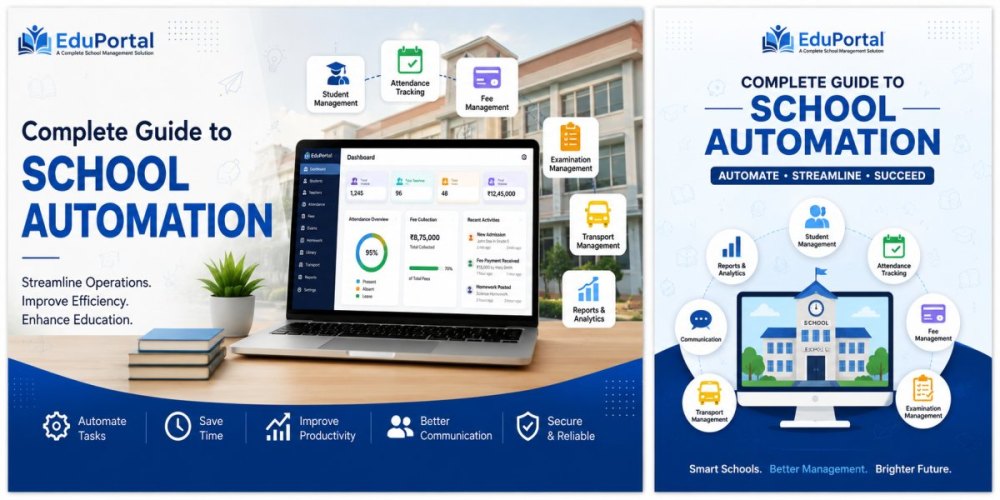
Complete Guide to School Automation
Educational institutions are facing increasing pressure to manage growing student populations, complex administrative requirements, parent expectations, and regulatory compliance. Traditional manual processes that once worked for schools are now becoming inefficient, time-consuming, and costly.
This is where School Automation plays a crucial role.
Whether you run a private school, public school, academy, college, or educational network, automation can transform how your institution operates and help your staff focus on education rather than paperwork.
This guide explains everything school leaders need to know about School Automation in 2026, including benefits, implementation strategies, common mistakes, and how modern solutions like EduPortal can help schools succeed.
What is School Automation?
School Automation refers to the use of software and digital tools to streamline and automate administrative, academic, and operational processes within an educational institution.
Instead of manually handling tasks across multiple departments, schools use an integrated platform that centralizes data and automates repetitive work.
Common Areas of School Automation
-
Student admissions
-
Attendance management
-
Fee collection
-
Examination management
-
Result generation
-
Parent communication
-
Timetable management
-
Transport tracking
-
Staff management
-
Payroll processing
-
Library management
-
Inventory management
-
Reporting and analytics
The goal is simple: reduce manual effort while improving accuracy and efficiency.
Why School Automation Matters in 2026
The education sector is undergoing rapid digital transformation.
Parents expect real-time updates. Teachers need efficient tools. Administrators require accurate reports. School owners need visibility into operations and financial performance.
Schools that continue relying on manual systems often face:
-
Administrative bottlenecks
-
Data inaccuracies
-
Delayed communication
-
Financial leakage
-
Limited reporting capabilities
-
Poor parent satisfaction
School Automation addresses these challenges by creating a connected and efficient ecosystem.
Key Drivers of School Automation in 2026
Increased Parent Expectations
Parents now expect instant access to attendance records, fee information, examination results, and school announcements.
Growing Administrative Complexity
Managing hundreds or thousands of students manually becomes increasingly difficult as institutions grow.
Demand for Data-Driven Decisions
School leaders need accurate data to improve operations, academic performance, and financial planning.
Digital-First Education Environment
Modern schools are expected to provide technology-enabled experiences for students, staff, and parents.
Traditional School Management vs School Automation
| Area | Traditional Management | School Automation |
|---|---|---|
| Attendance | Manual registers | Digital attendance tracking |
| Fee Collection | Manual records | Automated fee management |
| Communication | Phone calls and notices | Instant notifications |
| Reporting | Time-consuming | Real-time reports |
| Admissions | Paper-based process | Online admissions |
| Examination Management | Manual calculations | Automated grading and reporting |
| Data Access | Limited | Centralized and accessible |
| Accuracy | Higher risk of errors | Improved accuracy |
The difference becomes even more significant as student numbers increase.
Key Benefits of School Automation
Improved Administrative Efficiency
Automation eliminates repetitive tasks and reduces paperwork.
Staff can spend less time entering data and more time supporting students and educational activities.
Better Attendance Management
Digital attendance systems provide real-time visibility into student attendance patterns.
Schools can instantly notify parents about absences and generate attendance reports within seconds.
Streamlined Fee Collection
Automated fee management helps schools:
-
Track payments
-
Generate invoices
-
Send reminders
-
Monitor outstanding balances
-
Produce financial reports
This improves cash flow and reduces administrative effort.
Enhanced Parent Communication
Communication gaps often create frustration for parents.
School Automation enables schools to:
-
Share announcements
-
Send notifications
-
Provide academic updates
-
Communicate emergency information
All through a centralized platform.
Accurate Reporting
School leaders can access real-time reports related to:
-
Admissions
-
Attendance
-
Finances
-
Academic performance
-
Staff performance
This supports informed decision-making.
Better Student Experience
Students benefit from:
-
Faster administrative processes
-
Improved communication
-
Access to academic information
-
Organized educational environment
Real School Scenario: Before and After Automation
Before Automation
A private school with 1,200 students managed attendance manually.
Teachers recorded attendance on paper, office staff entered records into spreadsheets, and parents often complained about delays and inaccuracies.
The school spent several hours every day handling attendance-related tasks.
After Automation
The school implemented a School Management System.
Teachers marked attendance digitally, parents received instant notifications, and administrators accessed real-time attendance reports.
Administrative workload dropped significantly while parent satisfaction improved.
This scenario reflects the experience of many schools adopting automation.
School Automation Modules Every Institution Should Consider
Admission Management
Automates the entire admission process.
Features include:
-
Online applications
-
Document uploads
-
Admission tracking
-
Automated communication
Attendance Management
Tracks student attendance digitally.
Benefits include:
-
Faster record keeping
-
Real-time monitoring
-
Parent notifications
-
Detailed reporting
Fee Management
Simplifies financial operations.
Features include:
-
Invoice generation
-
Payment tracking
-
Fee reminders
-
Financial reporting
Examination Management
Supports:
-
Exam scheduling
-
Marks entry
-
Result generation
-
Performance analysis
Communication Management
Creates a direct communication channel between schools and parents.
Transport Management
Tracks routes, vehicles, and student transportation records.
Staff Management
Helps manage:
-
Employee records
-
Leave requests
-
Attendance
-
Payroll information
Common Mistakes Schools Make
Many schools invest in technology but fail to achieve expected results due to avoidable mistakes.
Choosing Software Based Only on Price
The cheapest solution is not always the best.
Schools should focus on long-term value, scalability, and support.
Ignoring Staff Training
Even the best system will fail if users are not properly trained.
Automating Only One Department
Partial automation creates information silos and reduces efficiency.
Schools should aim for integrated solutions.
Lack of Leadership Involvement
Successful implementation requires active participation from school leadership.
Not Defining Clear Objectives
Schools should establish measurable goals before implementation.
Examples include:
-
Reduce attendance processing time
-
Improve fee collection efficiency
-
Increase parent engagement
How to Successfully Implement School Automation
Step 1: Assess Current Processes
Identify manual tasks causing delays and inefficiencies.
Step 2: Define Objectives
Determine what improvements the school wants to achieve.
Step 3: Select the Right Platform
Look for a solution that offers:
-
Scalability
-
User-friendly interface
-
Mobile accessibility
-
Reliable support
Step 4: Train Staff
Provide adequate training to ensure smooth adoption.
Step 5: Monitor Performance
Track results and continuously improve workflows.
Expert Recommendation
For most schools in 2026, the best approach is to adopt a centralized School Management System rather than using multiple disconnected tools.
A unified platform helps schools:
-
Maintain a single source of truth
-
Improve operational efficiency
-
Enhance communication
-
Generate comprehensive reports
-
Scale as enrollment grows
School leaders should prioritize software that combines academic, administrative, financial, and communication functions within one integrated system.
This approach reduces complexity and maximizes return on investment.
How EduPortal Solves This Problem
EduPortal is designed specifically to help schools automate their daily operations through a centralized and user-friendly platform.
Admissions Management
EduPortal simplifies student enrollment through digital admission workflows.
Smart Attendance System
Schools can track attendance efficiently while providing real-time visibility to administrators and parents.
Fee Management
Automated fee tracking, reminders, and reporting improve financial management.
Examination Management
EduPortal streamlines exam scheduling, result generation, and academic performance analysis.
Parent Communication
Schools can instantly communicate announcements, updates, and notifications.
Comprehensive Reporting
Decision-makers gain access to actionable insights through real-time reports and dashboards.
Centralized School Management
All key operations are managed from a single platform, reducing complexity and improving efficiency.
By automating routine tasks, EduPortal enables schools to focus more on education and less on administration.
Frequently Asked Questions (FAQs)
1. What is School Automation?
School Automation is the use of technology to automate academic and administrative processes within educational institutions.
2. Why is School Automation important?
It improves efficiency, reduces manual work, minimizes errors, and enhances communication.
3. What are the benefits of School Automation?
Benefits include improved attendance tracking, streamlined fee collection, better communication, and real-time reporting.
4. How does School Automation improve attendance management?
Digital systems record attendance instantly and generate reports automatically.
5. Can small schools benefit from School Automation?
Yes. Schools of all sizes can improve efficiency through automation.
6. Is School Automation expensive?
Modern solutions offer scalable pricing, making automation accessible for many institutions.
7. How long does implementation take?
Implementation timelines vary depending on school size and requirements.
8. What features should a School Management System include?
Admissions, attendance, fee management, examinations, communication, reporting, and staff management.
9. How does automation improve parent engagement?
Parents receive real-time updates regarding attendance, results, fees, and announcements.
10. Does School Automation reduce paperwork?
Yes. Most routine administrative tasks become digital and automated.
11. Can School Automation improve fee collection?
Yes. Automated reminders and payment tracking improve collection efficiency.
12. Is School Automation suitable for colleges?
Absolutely. Colleges can automate many administrative and academic processes.
13. What challenges can automation solve?
Data inaccuracies, communication delays, administrative inefficiencies, and reporting challenges.
14. What is the future of School Automation?
The future includes greater use of analytics, mobile accessibility, AI-powered insights, and integrated digital ecosystems.
15. How can EduPortal help schools?
EduPortal provides a centralized platform for managing admissions, attendance, fees, examinations, communication, and reporting.
Conclusion
School Automation has become an essential strategy for educational institutions seeking operational excellence in 2026. By replacing manual processes with integrated digital systems, schools can improve efficiency, reduce administrative burdens, enhance communication, and make better decisions based on accurate data.
Whether your goal is to streamline admissions, improve attendance tracking, automate fee collection, or strengthen parent engagement, a modern School Management System can deliver measurable benefits across the entire institution.
Ready to Transform Your School?
Discover how EduPortal can help your institution automate operations, improve efficiency, and deliver a better educational experience for students, parents, teachers, and administrators.
Contact EduPortal today to schedule a demo and explore the future of School Automation.