Digital Fee Collection for Schools: Benefits, Challenges & Complete Guide (2026)
Quick Answer
Digital Fee Collection for Schools enables educational institutions to collect tuition fees, admission charges, transport fees, examination fees, and other payments through online and automated payment systems. Instead of relying on cash handling, manual receipts, and physical fee counters, schools can provide parents with secure and convenient digital payment options through mobile apps, online portals, banking integrations, and School ERP systems.
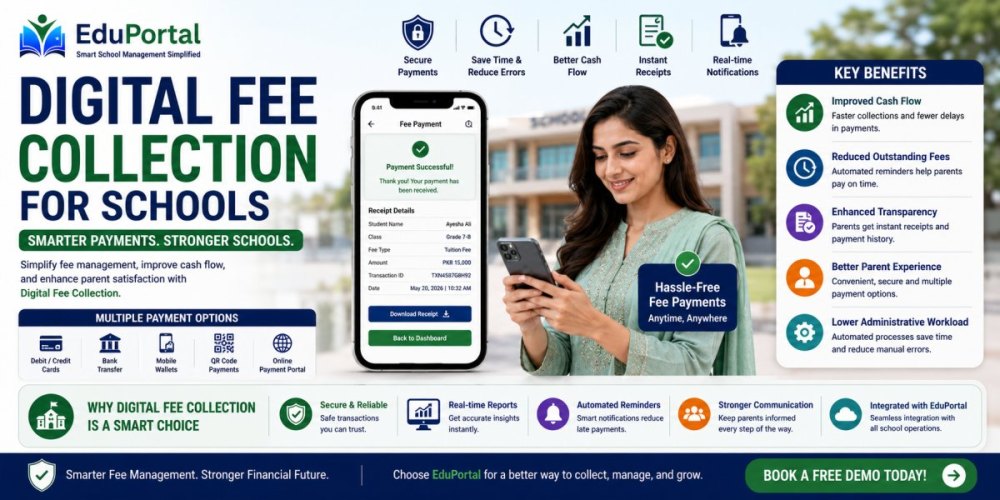
In 2026, digital fee collection has become an essential component of modern school management. It improves cash flow, reduces outstanding dues, enhances transparency, minimizes administrative workload, and provides a better experience for parents. Schools that adopt digital fee management systems gain greater financial control while improving operational efficiency and parent satisfaction.
Introduction
Fee collection is one of the most critical administrative functions in every educational institution.
Regardless of school size, consistent fee collection directly impacts financial stability, staff salaries, infrastructure development, and educational quality.
Traditionally, schools relied on manual fee collection processes.
Parents visited school offices, deposited cash, submitted bank challans, or waited in long queues to complete payments.
While these methods served schools for many years, they often created significant challenges.
Common issues included:
-
Delayed payments
-
Human errors
-
Outstanding dues
-
Manual reconciliation
-
Lost receipts
-
Administrative burden
As educational institutions continue embracing digital transformation, fee management is rapidly evolving.
Modern schools are adopting digital fee collection systems that simplify payments, improve transparency, and strengthen financial management.
For school owners, principals, and administrators, understanding the benefits of Digital Fee Collection for Schools is essential in 2026.
Why This Topic Matters in 2026
Several trends are accelerating the adoption of digital payment systems in education.
Growing Parent Expectations
Parents increasingly expect digital convenience.
They prefer:
-
Mobile payments
-
Online transactions
-
Instant receipts
-
Payment history access
Rising Administrative Complexity
As schools grow, managing thousands of transactions manually becomes difficult.
Demand for Financial Transparency
Schools need accurate and real-time financial visibility.
Increased Competition
Modern schools are adopting technology-driven parent services.
School Automation Initiatives
Digital fee collection is becoming a key component of complete school automation.
These factors make digital payment systems more important than ever.
What Is Digital Fee Collection?
Digital Fee Collection for Schools refers to the use of technology to automate fee payment, tracking, reconciliation, and reporting processes.
Parents can pay school fees through:
-
Mobile applications
-
Online portals
-
Internet banking
-
Debit cards
-
Credit cards
-
Digital wallets
-
QR code payments
-
Bank integrations
Payments are recorded automatically within the school's management system.
Traditional Fee Collection vs Digital Fee Collection
| Feature | Traditional Fee Collection | Digital Fee Collection |
|---|---|---|
| Payment Method | Cash / Manual Deposit | Online & Automated |
| Receipt Generation | Manual | Instant |
| Reconciliation | Time-Consuming | Automatic |
| Parent Convenience | Limited | High |
| Payment Tracking | Manual | Real-Time |
| Outstanding Monitoring | Difficult | Automated |
| Reporting | Manual | Instant |
| Transparency | Moderate | High |
| Scalability | Limited | Excellent |
The difference becomes increasingly significant as schools expand.
Major Benefits of Digital Fee Collection for Schools
Improved Cash Flow
One of the biggest advantages is faster fee collection.
Digital systems make payments easier, increasing the likelihood of timely payments.
Benefits
-
Reduced delays
-
Improved collection rates
-
Healthier cash flow
Schools can manage finances more effectively.
Reduced Outstanding Fees
Manual systems often rely on phone calls and reminders.
Digital systems automate:
-
Payment reminders
-
Due date notifications
-
Outstanding alerts
This helps reduce overdue balances.
Better Parent Experience
Parents value convenience.
With digital payment systems, parents can:
-
Pay anytime
-
Pay from anywhere
-
Access payment history
-
Download receipts instantly
The process becomes significantly easier.
Reduced Administrative Workload
Administrative teams spend less time:
-
Handling cash
-
Issuing receipts
-
Reconciling payments
-
Tracking dues
This improves productivity.
Improved Accuracy
Manual fee processing increases the risk of errors.
Automation minimizes:
-
Data entry mistakes
-
Duplicate entries
-
Calculation errors
Real-Time Financial Visibility
School leaders gain immediate access to financial information.
Administrators can monitor:
-
Collection performance
-
Outstanding balances
-
Revenue trends
-
Payment behavior
Enhanced Security
Digital payments reduce cash handling risks.
Benefits include:
-
Secure transactions
-
Digital audit trails
-
Better accountability
Faster Financial Reporting
Reports can be generated instantly.
Examples include:
-
Fee collection reports
-
Outstanding dues reports
-
Branch-wise revenue reports
-
Student payment history
How Digital Fee Collection Improves School Operations
Better Planning
Accurate financial data supports budgeting and forecasting.
Increased Transparency
Parents and administrators have access to the same information.
Stronger Parent-School Relationships
Convenient payment experiences improve satisfaction.
Reduced Office Congestion
Fewer parents need to visit school for payments.
Improved Decision Making
Real-time financial insights support strategic planning.
Real School Scenario
A private school network with 4,500 students relied on manual fee collection.
Challenges
-
Long payment queues
-
Outstanding balances
-
Reconciliation delays
-
Parent complaints
Solution
The school implemented a digital fee management system integrated with its School ERP platform.
Results Within One Academic Year
-
Fee collection rates increased significantly
-
Outstanding balances decreased
-
Administrative workload reduced
-
Parent satisfaction improved
-
Financial reporting became real-time
The institution achieved both operational and financial improvements.
Essential Features of a Digital Fee Collection System
Online Payment Gateway Integration
Support multiple payment methods.
Automated Fee Reminders
Reduce overdue payments.
Instant Receipt Generation
Improve transparency and record-keeping.
Parent Mobile App Integration
Provide convenient access to payment information.
Fee Structure Management
Support multiple fee categories and payment plans.
Real-Time Reporting
Enable better financial visibility.
School ERP Integration
Connect finance with attendance, admissions, academics, and communication.
Multi-Campus Support
Manage finances across multiple branches.
Common Challenges During Implementation
Staff Resistance
Employees may require time to adapt.
Parent Adoption
Some families may initially prefer traditional payment methods.
Technology Selection
Choosing the right platform is critical.
Process Standardization
Schools should review and optimize fee workflows before digitization.
Common Mistakes Schools Make
Offering Limited Payment Options
Parents expect flexibility.
Failing to Automate Reminders
Manual follow-ups consume valuable time.
Ignoring ERP Integration
Disconnected systems reduce efficiency.
Choosing Based Solely on Cost
Long-term value matters more than initial price.
Not Communicating Benefits to Parents
Successful adoption requires awareness and education.
Expert Recommendation
Small Schools
Start with:
-
Online fee payments
-
Automated reminders
-
Digital receipts
Medium Schools
Add:
-
Parent mobile apps
-
Financial dashboards
-
Advanced reporting
Large Educational Networks
Implement:
-
Full School ERP integration
-
Multi-campus fee management
-
Analytics and forecasting
The most successful schools view digital fee collection as part of a broader digital transformation strategy.
How EduPortal Solves This Problem
EduPortal provides a complete Digital Fee Collection for Schools solution designed for modern educational institutions.
Online Fee Payments
Allow parents to pay securely from anywhere.
Automated Fee Reminders
Reduce outstanding balances through intelligent notifications.
Parent Mobile App
Provide instant access to payment history and due information.
Real-Time Reporting
Monitor collections, dues, and revenue performance.
Smart Fee Structure Management
Handle tuition, transport, examination, and miscellaneous charges.
Multi-Campus Support
Manage collections across multiple branches.
ERP Integration
Connect fee management with admissions, attendance, academics, and communication.
Financial Transparency
Improve accountability through automated records and reporting.
EduPortal helps schools simplify fee collection while improving financial performance.
Frequently Asked Questions
1. What is Digital Fee Collection for Schools?
It is the use of technology to automate fee payments, tracking, reporting, and reconciliation.
2. Why should schools adopt digital fee collection?
It improves efficiency, transparency, and collection rates.
3. Can parents pay fees through mobile phones?
Yes. Modern systems support mobile payments.
4. Does digital fee collection reduce outstanding dues?
Yes. Automated reminders improve payment compliance.
5. Is digital fee collection secure?
Yes. Reputable platforms use secure payment technologies.
6. Can schools generate instant receipts?
Absolutely.
7. How does digital fee collection improve cash flow?
It makes payments easier and encourages timely payments.
8. Can schools track payments in real time?
Yes. Administrators gain instant visibility.
9. Is digital fee collection suitable for small schools?
Yes. Schools of all sizes benefit.
10. Can digital systems integrate with School ERP software?
Yes. Integration is one of the biggest advantages.
11. How does digital fee collection improve parent satisfaction?
It offers convenience, transparency, and faster service.
12. What payment methods can schools support?
Bank transfers, cards, wallets, QR payments, and more.
13. Can schools manage multiple fee structures?
Yes. Modern systems support flexible configurations.
14. What reports are available?
Collection reports, outstanding reports, revenue reports, and payment histories.
15. Why choose EduPortal?
EduPortal provides complete digital fee management, automation, reporting, and parent engagement capabilities in one integrated platform.
Conclusion
The future of school finance is digital.
By implementing Digital Fee Collection for Schools, educational institutions can improve cash flow, reduce outstanding balances, strengthen financial transparency, and provide a better experience for parents.
Digital payment systems not only simplify fee management but also support broader school automation and operational excellence.
Schools that embrace digital fee collection today will be better positioned to manage growth, improve efficiency, and meet the expectations of modern families.
Ready to Modernize School Fee Collection?
Discover how EduPortal can help your institution automate payments, reduce outstanding dues, improve parent satisfaction, and strengthen financial management.
Book an EduPortal demo today and experience smarter fee collection for your school.