How Data Analytics Helps Schools Improve Student Performance in 2026
Quick Answer
Student Performance Analytics is the process of collecting, analyzing, and interpreting student data to improve academic outcomes, identify learning gaps, monitor progress, and support better educational decision-making. By using data from attendance records, examinations, assignments, assessments, classroom participation, and behavioral reports, schools can gain actionable insights into student performance.
In 2026, educational institutions are increasingly relying on Student Performance Analytics to move beyond guesswork and make evidence-based decisions. Schools that leverage data analytics can identify struggling students earlier, personalize learning strategies, improve academic achievement, strengthen parent communication, and enhance overall institutional performance. Rather than reacting to problems after they occur, data analytics enables schools to proactively support student success.
Introduction
For many years, schools evaluated student success primarily through examination results and teacher observations.
While these methods remain important, they often provide only a partial picture of a student's educational journey.
Today's educational environment generates vast amounts of data every day:
-
Attendance records
-
Examination scores
-
Homework submissions
-
Classroom participation
-
Behavioral reports
-
Parent interactions
-
Learning progress metrics
When used effectively, this information becomes a powerful tool for improving student outcomes.
This is where Student Performance Analytics plays a critical role.
Modern schools are increasingly using analytics to identify learning challenges, predict academic risks, personalize support strategies, and improve educational decision-making.
For school owners, principals, and administrators, data analytics is no longer simply a reporting tool—it is becoming a strategic asset that supports student achievement and institutional growth.
This guide explores how Student Performance Analytics is transforming education and helping schools create better learning outcomes in 2026.
Why This Topic Matters in 2026
Education is becoming increasingly data-driven.
School leaders are expected to make faster and more informed decisions while managing growing student populations and rising expectations from parents.
Several factors make Student Performance Analytics more important than ever.
Increased Academic Accountability
Schools are under pressure to demonstrate measurable educational outcomes.
Personalized Learning Expectations
Students require different levels of support and intervention.
Early Risk Identification
Schools need systems that identify struggling students before performance declines significantly.
Parent Demand for Transparency
Parents expect detailed insights into academic progress.
AI and Educational Technology Growth
Modern School ERP systems now provide advanced analytics capabilities that were previously unavailable.
Schools that fail to utilize educational data effectively risk falling behind in both academic performance and operational efficiency.
What Is Student Performance Analytics?
Student Performance Analytics refers to the systematic collection and analysis of student-related data to improve educational outcomes.
Rather than focusing solely on final grades, analytics examines multiple factors that influence performance.
Data Sources Commonly Analyzed
-
Attendance records
-
Examination results
-
Assignment completion rates
-
Classroom participation
-
Behavioral records
-
Homework submissions
-
Assessment scores
-
Parent engagement data
The goal is to transform raw information into actionable insights.
Traditional Performance Monitoring vs Student Performance Analytics
| Area | Traditional Approach | Student Performance Analytics |
|---|---|---|
| Student Assessment | Periodic Exams | Continuous Monitoring |
| Intervention Timing | Reactive | Proactive |
| Data Sources | Limited | Multiple Sources |
| Decision Making | Observation-Based | Data-Driven |
| Reporting | Static Reports | Real-Time Dashboards |
| Parent Visibility | Limited | Comprehensive |
| Risk Identification | Delayed | Early Detection |
| Learning Support | Generalized | Personalized |
The difference becomes increasingly valuable as schools seek to improve outcomes at scale.
How Student Performance Analytics Improves Student Outcomes
Early Identification of At-Risk Students
One of the greatest benefits of analytics is the ability to identify students who may require additional support.
Analytics can reveal patterns such as:
-
Declining attendance
-
Falling grades
-
Reduced participation
-
Missed assignments
Example
A student whose attendance decreases and assignment completion drops may be flagged for intervention before examination results are affected.
This proactive approach improves success rates.
Personalized Learning Strategies
Every student learns differently.
Student Performance Analytics helps educators understand:
-
Learning strengths
-
Weaknesses
-
Subject-specific challenges
-
Progress trends
Teachers can then adapt instructional approaches accordingly.
Example
Students struggling in mathematics can receive targeted support while advanced learners receive enrichment opportunities.
Better Attendance Monitoring
Attendance strongly influences academic performance.
Analytics can help schools identify:
-
Frequent absenteeism
-
Attendance trends
-
Students at risk of disengagement
This enables earlier intervention and stronger accountability.
Improved Examination Performance
Analytics helps schools understand:
-
Subject performance trends
-
Assessment effectiveness
-
Class-wide achievement patterns
Teachers can adjust teaching strategies based on actual performance data.
Data-Driven Academic Interventions
Instead of relying solely on assumptions, schools can use evidence-based interventions.
Examples
-
Academic support programs
-
Tutoring initiatives
-
Parent meetings
-
Personalized learning plans
Interventions become more effective when supported by data.
Enhanced Parent Communication
Parents appreciate transparency.
Analytics enables schools to provide:
-
Progress reports
-
Attendance insights
-
Performance trends
-
Improvement recommendations
Better communication strengthens collaboration between schools and families.
Improved Resource Allocation
Analytics helps administrators allocate resources more effectively.
Examples
-
Teacher assignments
-
Learning support services
-
Intervention programs
-
Academic resources
Data ensures resources are directed where they are needed most.
Predictive Academic Insights
Modern analytics systems can identify future risks based on historical data.
Benefits
-
Early intervention
-
Reduced academic failure
-
Better student retention
-
Improved planning
Predictive analytics is becoming one of the most valuable educational technologies in 2026.
Key Metrics Schools Should Track
To maximize the value of Student Performance Analytics, schools should monitor several important indicators.
Attendance Rate
Attendance remains one of the strongest predictors of academic success.
Assessment Scores
Track trends across subjects and grade levels.
Assignment Completion Rate
Measure engagement and learning consistency.
Academic Growth
Evaluate progress over time rather than relying solely on final results.
Behavioral Indicators
Analyze patterns that may impact learning.
Parent Engagement
Monitor communication and involvement levels.
Intervention Outcomes
Assess whether support strategies are producing measurable improvements.
Real School Scenario
A private school with approximately 2,800 students struggled to identify students requiring academic support.
Challenges
-
Reactive intervention processes
-
Limited performance visibility
-
Inconsistent reporting
-
Difficulty tracking progress over time
Solution
The school implemented a Student Performance Analytics platform integrated with its School ERP.
Results After One Academic Year
-
Early identification of struggling students improved significantly
-
Academic intervention programs became more effective
-
Parent engagement increased
-
Reporting accuracy improved
-
Leadership gained deeper visibility into school-wide performance trends
The institution reported measurable improvements in student achievement and administrative efficiency.
Common Mistakes Schools Make
Focusing Only on Final Grades
Grades provide valuable information but do not tell the entire story.
Attendance, participation, and engagement are equally important.
Collecting Data Without Analysis
Many schools gather large amounts of data but fail to use it effectively.
Delaying Intervention
Waiting until examination results are available often reduces intervention effectiveness.
Ignoring Attendance Trends
Attendance data frequently reveals academic risks before grades decline.
Using Disconnected Systems
Data becomes more valuable when integrated into a centralized School ERP platform.
Expert Recommendation
Small Schools
Focus on:
-
Attendance analytics
-
Academic reporting
-
Parent communication
Medium-Sized Schools
Add:
-
Predictive analytics
-
Performance dashboards
-
Intervention tracking
Large Educational Networks
Prioritize:
-
Multi-campus reporting
-
AI-powered analytics
-
Strategic forecasting
-
Advanced performance monitoring
Schools should focus on using analytics to improve decisions rather than simply generating reports.
How EduPortal Solves This Problem
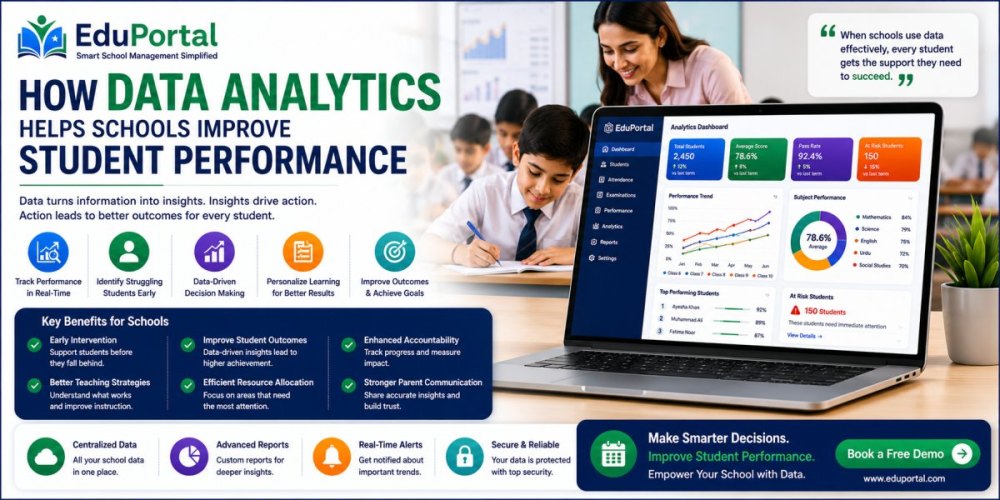
EduPortal provides powerful Student Performance Analytics tools designed to help schools improve educational outcomes.
Real-Time Academic Dashboards
Monitor performance trends instantly.
Attendance Analytics
Identify attendance-related risks early.
Examination Performance Tracking
Analyze academic achievement across classes and subjects.
Student Progress Monitoring
Track growth over time rather than relying solely on final grades.
Parent Communication Tools
Share performance updates and insights with families.
Advanced Reporting
Generate detailed academic reports and analytics.
Cloud-Based Accessibility
Access performance data securely from anywhere.
Integrated School Management
Connect analytics with attendance, examinations, communication, and administrative systems.
EduPortal helps schools transform educational data into meaningful action that supports student success.
Frequently Asked Questions
1. What is Student Performance Analytics?
Student Performance Analytics is the process of analyzing student data to improve educational outcomes and decision-making.
2. Why is Student Performance Analytics important?
It helps schools identify learning challenges, improve interventions, and support academic success.
3. What data is used in performance analytics?
Attendance, grades, assessments, participation, assignments, and behavioral records.
4. How does analytics improve student performance?
It enables early intervention and personalized support.
5. Can analytics identify at-risk students?
Yes. Analytics helps schools detect warning signs before performance declines significantly.
6. How does attendance affect analytics?
Attendance is a key predictor of academic success and engagement.
7. Can small schools benefit from analytics?
Absolutely. Schools of all sizes can make better decisions using data.
8. Does analytics improve parent communication?
Yes. Schools can provide more detailed and transparent performance updates.
9. What is predictive analytics in education?
Predictive analytics uses historical data to forecast future performance trends.
10. How does analytics support teachers?
It provides insights that help educators personalize instruction.
11. Can analytics improve examination performance?
Yes. Schools can identify weaknesses and adjust teaching strategies accordingly.
12. Is Student Performance Analytics secure?
Modern cloud-based systems include strong security measures.
13. How does EduPortal support analytics?
EduPortal provides dashboards, reports, attendance insights, and performance tracking tools.
14. Can analytics improve school-wide outcomes?
Yes. Data-driven decisions often lead to measurable improvements.
15. Why should schools invest in Student Performance Analytics?
Because it helps improve academic results, operational efficiency, and student success.
Conclusion
The future of education belongs to schools that can transform information into action. Student Performance Analytics provides educational institutions with the visibility, intelligence, and insights needed to improve student outcomes and make better decisions.
Rather than waiting for academic problems to become visible through examination results, schools can use analytics to identify risks early, personalize support, improve communication, and strengthen educational performance across the institution.
As schools continue embracing digital transformation in 2026, Student Performance Analytics is becoming an essential component of modern educational management.
Ready to Improve Student Outcomes?
Discover how EduPortal's Student Performance Analytics tools can help your institution monitor progress, identify risks, and support student success through data-driven decision-making.
Book an EduPortal demo today and unlock the power of educational analytics.