How Technology Is Changing Education in Pakistan in 2026
Quick Answer
Technology in Education Pakistan is transforming how schools teach, manage operations, communicate with parents, and support student learning. From School ERP systems and digital admissions to AI-powered learning tools, online assessments, and parent mobile apps, educational institutions across Pakistan are embracing technology to improve efficiency and educational outcomes.
In 2026, schools that leverage technology gain significant advantages in administration, communication, student engagement, and decision-making. Digital transformation enables institutions to automate repetitive tasks, provide better learning experiences, increase transparency, and prepare students for a technology-driven future. As educational expectations continue to evolve, technology has become a necessity rather than a luxury for schools across Pakistan.
Introduction
The education sector in Pakistan is undergoing one of the most significant transformations in its history.
For decades, classrooms relied primarily on traditional teaching methods, paper-based administration, manual attendance registers, and physical record-keeping systems.
While these methods served schools for many years, the demands of modern education require a different approach.
Today's students are growing up in a digital world.
Parents expect real-time communication and transparency.
Administrators need accurate data to make informed decisions.
Teachers require tools that improve learning outcomes and reduce administrative workload.
As a result, technology is rapidly becoming the foundation of modern education in Pakistan.
From digital classrooms and School ERP systems to artificial intelligence and cloud-based management platforms, technology is reshaping how schools operate and how students learn.
This guide explores how Technology in Education Pakistan is changing schools in 2026 and what educational leaders should know to stay ahead.
Why This Topic Matters in 2026
Educational technology adoption has accelerated significantly over the past few years.
Several factors are driving this transformation.
Growing Student Populations
Schools must manage larger numbers of students while maintaining educational quality.
Technology helps institutions scale effectively.
Increased Parent Expectations
Parents now expect:
-
Mobile access to information
-
Attendance updates
-
Online fee payments
-
Academic progress reports
Administrative Efficiency
Schools are seeking ways to reduce paperwork and automate repetitive processes.
Global Educational Trends
Educational institutions in Pakistan are aligning with international best practices.
AI and Digital Learning Growth
Artificial intelligence and digital learning platforms are creating new opportunities for personalized education.
Technology is becoming central to educational success.
The Evolution of Education in Pakistan
Traditional education systems focused heavily on manual administration and classroom-based instruction.
Today, schools are transitioning toward:
-
Smart classrooms
-
Digital administration
-
Online communication
-
Data-driven decision-making
-
Personalized learning
This shift is improving both educational quality and operational efficiency.
Traditional Schools vs Technology-Driven Schools
| Area | Traditional Schools | Technology-Driven Schools |
|---|---|---|
| Attendance | Manual Registers | Digital Tracking |
| Fee Collection | Cash & Paper Records | Online Payments |
| Parent Communication | Circulars & Calls | Real-Time Notifications |
| Student Records | Filing Cabinets | Centralized Databases |
| Reporting | Manual Compilation | Automated Reports |
| Learning Resources | Printed Materials | Digital Content |
| Decision Making | Historical Information | Real-Time Analytics |
| Accessibility | School Premises Only | Anywhere Access |
The difference becomes increasingly important as schools modernize.
Key Ways Technology Is Changing Education in Pakistan
Digital Learning Platforms
Digital learning tools provide students with access to educational resources beyond traditional textbooks.
Benefits
-
Interactive learning
-
Flexible access
-
Multimedia content
-
Enhanced engagement
Students can learn anytime and anywhere.
School ERP Systems
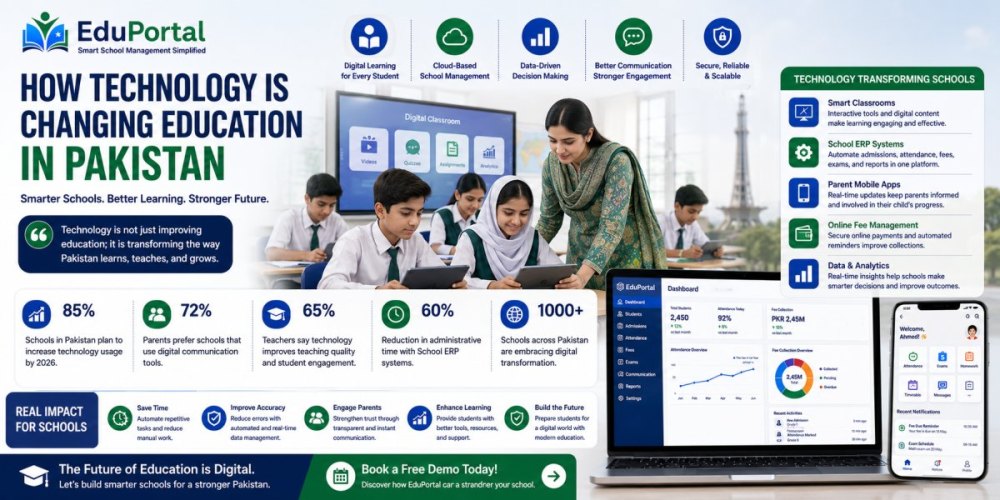
One of the most significant technological developments is the adoption of School ERP systems.
These platforms automate:
-
Admissions
-
Attendance
-
Fees
-
Examinations
-
Communication
ERP systems improve efficiency across the institution.
Parent Communication Apps
Modern parents want instant access to school information.
Parent apps provide:
-
Attendance updates
-
Examination results
-
Homework notifications
-
Fee information
This strengthens parent engagement.
Online Fee Management
Digital payment systems simplify financial operations.
Benefits include:
-
Faster collections
-
Improved transparency
-
Reduced administrative workload
Schools experience healthier cash flow.
Smart Attendance Systems
Attendance management has evolved significantly.
Schools now use:
-
Mobile attendance apps
-
RFID systems
-
Biometric tracking
-
Real-time reporting
These systems improve accuracy and accountability.
Data Analytics for Student Performance
Educational institutions are increasingly using analytics to improve learning outcomes.
Administrators can identify:
-
At-risk students
-
Attendance patterns
-
Academic trends
-
Performance gaps
Data-driven insights support better interventions.
Artificial Intelligence in Education
AI is beginning to transform educational experiences.
Applications include:
-
Personalized learning
-
Intelligent tutoring
-
Automated assessments
-
Learning recommendations
AI helps create more effective learning environments.
Cloud-Based School Management
Cloud technology enables schools to access information securely from anywhere.
Advantages include:
-
Remote access
-
Centralized management
-
Automatic backups
-
Improved scalability
Cloud systems are becoming the standard.
Benefits of Educational Technology for Schools
Improved Operational Efficiency
Technology reduces administrative workload and increases productivity.
Better Communication
Parents, teachers, and administrators stay connected through digital platforms.
Enhanced Learning Experiences
Students benefit from interactive and engaging educational tools.
Greater Transparency
Real-time information improves trust and accountability.
Improved Decision Making
School leaders gain access to actionable insights.
Scalability
Technology supports school growth without significantly increasing administrative complexity.
Real School Scenario
A private school in Pakistan with approximately 2,800 students faced several operational challenges.
Problems
-
Manual attendance tracking
-
Delayed parent communication
-
Time-consuming reporting
-
Fee collection inefficiencies
Solution
The school implemented a cloud-based School ERP system integrated with parent communication tools.
Results
Within one academic year:
-
Administrative workload decreased
-
Attendance accuracy improved
-
Parent engagement increased
-
Reporting became real-time
-
Fee collection efficiency improved
The institution achieved significant operational improvements.
Challenges Schools Face During Digital Transformation
Resistance to Change
Staff may be hesitant to adopt new systems.
Lack of Training
Technology adoption requires proper onboarding and support.
Choosing the Wrong Software
Schools should carefully evaluate technology providers.
Budget Concerns
Many institutions focus on short-term costs rather than long-term benefits.
Common Mistakes Schools Make
Delaying Technology Adoption
Waiting too long often creates competitive disadvantages.
Implementing Too Many Systems
Disconnected tools can create operational complexity.
Ignoring Staff Training
Technology is only effective when users understand it.
Focusing Only on Features
Schools should prioritize outcomes rather than software specifications.
Neglecting Parent Engagement
Technology should improve communication, not complicate it.
Expert Recommendation
Small Schools
Start with:
-
School ERP
-
Parent communication tools
-
Attendance management
Medium-Sized Schools
Add:
-
Fee management
-
Analytics
-
Online admissions
Large Educational Groups
Invest in:
-
Multi-campus management
-
AI-powered analytics
-
Advanced reporting
-
Cloud infrastructure
Schools should view technology as a long-term strategic investment.
How EduPortal Solves This Problem
EduPortal is designed to help schools embrace digital transformation confidently.
Complete School Automation
Manage admissions, attendance, fees, examinations, and communication from one platform.
Parent Mobile App
Keep parents informed through real-time updates.
Smart Fee Management
Improve collections and financial transparency.
Attendance Automation
Track attendance efficiently and accurately.
Advanced Analytics
Transform data into actionable insights.
Multi-Campus Support
Manage multiple branches through a centralized dashboard.
Cloud-Based Accessibility
Access school operations securely from anywhere.
User-Friendly Experience
Ensure smooth adoption for administrators, teachers, and parents.
EduPortal helps schools modernize operations while improving educational outcomes.
Frequently Asked Questions
1. How is technology changing education in Pakistan?
Technology is improving learning, administration, communication, and decision-making across educational institutions.
2. Why is educational technology important?
It improves efficiency, engagement, transparency, and educational quality.
3. What role do School ERP systems play?
ERP systems automate administrative and academic processes.
4. Can technology improve student performance?
Yes. Data analytics and personalized learning tools support better outcomes.
5. How do parent apps help schools?
They improve communication and increase parent engagement.
6. What is a digital classroom?
A classroom that uses technology to enhance teaching and learning.
7. How does cloud technology benefit schools?
It provides secure access, scalability, and centralized management.
8. Is educational technology suitable for small schools?
Absolutely. Schools of all sizes can benefit.
9. What challenges do schools face during digital transformation?
Training, adoption, budget concerns, and software selection.
10. How does technology improve attendance management?
Through automation, real-time tracking, and reporting.
11. What is AI in education?
Artificial intelligence used to personalize learning and automate educational processes.
12. How does technology improve fee management?
It enables online payments, automated reminders, and better financial visibility.
13. Can schools manage multiple campuses through technology?
Yes. Modern School ERP systems support centralized multi-campus management.
14. What should schools prioritize first?
Admissions, attendance, communication, and fee management.
15. Why choose EduPortal?
EduPortal provides a complete digital ecosystem for modern school management.
Conclusion
Technology is fundamentally reshaping education in Pakistan. From digital classrooms and AI-powered learning to School ERP systems and parent communication apps, educational institutions are discovering new ways to improve efficiency, engagement, and academic outcomes.
Schools that embrace technology today are building stronger foundations for tomorrow. They are better equipped to meet parent expectations, support teachers, improve student performance, and scale sustainably.
As Pakistan's education sector continues evolving in 2026, technology will remain one of the most powerful tools for driving educational excellence.
Ready to Transform Your School?
Discover how EduPortal can help your institution automate operations, improve communication, and embrace the future of education.
Book an EduPortal demo today and start your digital transformation journey.