
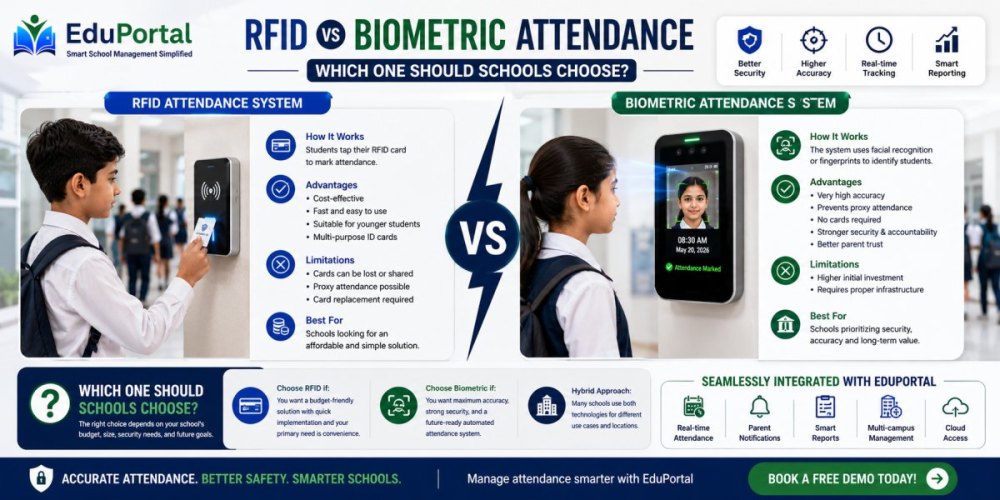
RFID vs Biometric Attendance: Which One Should Schools Choose in 2026?
Quick Answer
When comparing RFID vs Biometric Attendance System, both technologies offer significant improvements over traditional attendance registers, but they serve different purposes. RFID attendance systems use smart cards or ID cards to record attendance quickly, while biometric attendance systems use unique physical characteristics such as facial recognition or fingerprints for identification.
For most modern schools in 2026, biometric attendance systems provide higher accuracy, stronger security, and eliminate proxy attendance. RFID systems, on the other hand, are generally more affordable, faster to deploy, and easier for younger students to use. The right choice depends on a school's size, budget, security requirements, and automation goals. Schools looking for maximum accountability and integration with School ERP systems often prefer biometric attendance solutions, while RFID remains a practical option for institutions seeking a cost-effective attendance system.
Introduction
Attendance management is one of the most critical operational functions in any educational institution.
Accurate attendance records help schools:
-
Monitor student participation
-
Improve safety
-
Enhance parent communication
-
Meet regulatory requirements
-
Support academic success
For decades, schools relied on manual attendance registers.
While functional, these systems are time-consuming and prone to errors.
Today, educational institutions are increasingly turning to automated attendance technologies.
Two of the most widely adopted solutions are:
-
RFID Attendance Systems
-
Biometric Attendance Systems
Both technologies help schools automate attendance tracking, but they operate differently and offer distinct advantages.
For school owners, principals, and administrators, choosing the right attendance technology can significantly impact efficiency, security, and operational performance.
This guide compares RFID vs Biometric Attendance Systems to help schools make informed decisions.
Why This Topic Matters in 2026
Educational institutions are becoming increasingly technology-driven.
Several trends are influencing attendance management decisions.
Growing Student Populations
Larger enrollments require scalable attendance solutions.
Increased Focus on Student Safety
Schools need accurate records of student presence.
Parent Expectations
Parents expect real-time attendance updates.
School Automation Initiatives
Attendance systems are often the foundation of school digital transformation.
Data-Driven Administration
Accurate attendance data supports better decision-making.
These factors make attendance technology selection more important than ever.
What Is an RFID Attendance System?
RFID stands for Radio Frequency Identification.
RFID attendance systems use smart cards or RFID-enabled ID cards to record attendance.
How RFID Works
-
Each student receives an RFID card.
-
The student taps or scans the card.
-
The system records attendance automatically.
-
Attendance data syncs with the school's management platform.
RFID is commonly used in schools, transportation systems, and access control applications.
What Is a Biometric Attendance System?
A Biometric Attendance System uses unique biological characteristics to identify individuals.
Common biometric technologies include:
-
Face Recognition
-
Fingerprint Recognition
-
Iris Recognition
-
Palm Recognition
The system verifies identity automatically and records attendance without requiring physical cards.
RFID vs Biometric Attendance System: Detailed Comparison
| Feature | RFID Attendance | Biometric Attendance |
|---|---|---|
| Accuracy | High | Very High |
| Proxy Attendance | Possible | Virtually Eliminated |
| Student Identification | Card-Based | Identity-Based |
| Security | Good | Excellent |
| Setup Cost | Lower | Higher |
| Operating Cost | Moderate | Low |
| Card Replacement | Required | Not Required |
| Parent Trust | High | Very High |
| Reporting | Advanced | Advanced |
| ERP Integration | Excellent | Excellent |
| Long-Term Value | Good | Excellent |
| Student Convenience | High | Very High |
Biometric systems generally offer stronger accountability and accuracy.
Advantages of RFID Attendance Systems
Cost-Effective Implementation
RFID solutions are usually more affordable initially.
This makes them attractive for budget-conscious schools.
Quick Attendance Recording
Students simply tap their cards.
The process is fast and efficient.
Easy Adoption
Students are familiar with ID cards.
Training requirements are minimal.
Multi-Purpose Usage
RFID cards can support:
-
Attendance
-
Library access
-
Transportation tracking
-
Campus entry
Suitable for Younger Students
Primary school students often adapt easily to RFID-based systems.
Limitations of RFID Attendance Systems
Card Loss or Damage
Students may:
-
Lose cards
-
Forget cards
-
Damage cards
This creates operational challenges.
Possibility of Proxy Attendance
Students can sometimes use another student's card.
This affects attendance accuracy.
Ongoing Card Management
Schools must manage card issuance and replacement.
Advantages of Biometric Attendance Systems
Superior Accuracy
Biometric attendance is based on unique physical characteristics.
Identity verification is highly reliable.
Elimination of Proxy Attendance
Students cannot easily impersonate others.
This strengthens accountability.
No Physical Cards Required
Schools eliminate card-related issues.
Improved Student Safety
Administrators know exactly who is on campus.
Enhanced Parent Confidence
Parents trust attendance records more when biometric verification is used.
Better Long-Term Efficiency
Reduced administrative overhead improves operational performance.
Limitations of Biometric Attendance Systems
Higher Initial Investment
Hardware costs are generally higher.
Infrastructure Requirements
Reliable connectivity may be required.
User Acceptance
Schools should communicate clearly with parents regarding biometric data usage.
Face Recognition vs Fingerprint Attendance
In 2026, face recognition is becoming the preferred biometric solution for schools.
| Feature | Fingerprint | Face Recognition |
|---|---|---|
| Contactless | No | Yes |
| Hygiene | Moderate | Excellent |
| Speed | Fast | Very Fast |
| User Experience | Good | Excellent |
| Student Acceptance | High | Very High |
| Modernity | Good | Excellent |
Many schools are transitioning toward face recognition technology.
Real School Scenario
A private school with 4,000 students initially implemented RFID attendance.
Challenges
-
Lost cards
-
Card replacements
-
Occasional proxy attendance
-
Parent concerns regarding accuracy
Solution
The school upgraded to a facial recognition biometric attendance system integrated with its School ERP.
Results
Within one academic year:
-
Attendance accuracy improved significantly
-
Card management costs disappeared
-
Parent satisfaction increased
-
Administrative workload decreased
-
Real-time attendance reporting improved
The school achieved better accountability and operational efficiency.
Which Attendance System Is Better for Different School Types?
Small Schools
Recommended
RFID or entry-level biometric systems.
Why
Lower implementation costs.
Medium-Sized Schools
Recommended
Face recognition attendance systems.
Why
Better balance between efficiency and scalability.
Large Educational Institutions
Recommended
Advanced biometric attendance integrated with School ERP software.
Why
Maximum accuracy and operational visibility.
Multi-Campus School Networks
Recommended
Cloud-connected biometric systems.
Why
Centralized attendance management across campuses.
Common Mistakes Schools Make
Focusing Only on Initial Cost
Long-term operational benefits matter more than purchase price.
Ignoring ERP Integration
Attendance systems should connect with school management software.
Choosing Technology Without Future Planning
Schools should select solutions that support growth.
Overlooking Parent Communication
Attendance systems should support real-time parent notifications.
Neglecting Staff Training
Successful adoption requires proper onboarding.
Expert Recommendation
For most schools in 2026, face recognition biometric attendance systems provide the strongest combination of:
-
Accuracy
-
Security
-
Automation
-
Parent confidence
-
Long-term value
RFID remains an excellent option for schools with limited budgets or younger student populations.
However, institutions planning long-term digital transformation should consider biometric attendance as part of a broader smart school strategy.
How EduPortal Solves This Problem
EduPortal supports both RFID and biometric attendance technologies through seamless integration.
Face Recognition Integration
Connect advanced biometric attendance devices directly with school records.
RFID Attendance Support
Manage card-based attendance efficiently.
Real-Time Attendance Monitoring
Track attendance instantly across campuses.
Parent Notifications
Automatically notify parents about attendance events.
Attendance Analytics
Generate detailed attendance reports and trends.
School ERP Integration
Attendance data connects with academics, fees, communication, and reporting.
Multi-Campus Management
Monitor attendance centrally from one platform.
EduPortal allows schools to choose the attendance technology that best fits their operational needs while maintaining complete visibility and control.
Frequently Asked Questions
1. What is the difference between RFID and biometric attendance?
RFID uses cards, while biometric systems use physical characteristics for identification.
2. Which system is more accurate?
Biometric attendance systems provide greater accuracy.
3. Can RFID attendance prevent proxy attendance?
Not completely.
4. Can biometric attendance eliminate proxy attendance?
Yes, in most cases.
5. Which system is more affordable?
RFID systems generally have lower initial costs.
6. What is the best biometric technology for schools?
Face recognition is becoming the preferred option.
7. Can attendance systems integrate with School ERP software?
Yes. Modern systems support ERP integration.
8. Which system is better for large schools?
Biometric attendance systems.
9. Can parents receive attendance notifications?
Yes. Both systems can support real-time alerts.
10. Is facial recognition safe for schools?
Yes. Modern systems use secure verification technologies.
11. Do RFID cards require replacement?
Occasionally, due to loss or damage.
12. Which system requires less maintenance?
Biometric systems generally require less day-to-day management.
13. Can schools use both RFID and biometric attendance?
Yes. Hybrid approaches are common.
14. Which system is better for future-ready schools?
Biometric attendance systems.
15. Why choose EduPortal?
EduPortal supports both RFID and biometric attendance while providing complete attendance management, reporting, and communication capabilities.
Conclusion
The debate between RFID vs Biometric Attendance System ultimately depends on a school's goals, budget, and long-term vision.
RFID systems offer affordability, ease of use, and reliable performance. However, biometric attendance systems provide superior accuracy, stronger security, and better long-term value.
For schools focused on digital transformation, smart school initiatives, and improved accountability, biometric attendance—particularly facial recognition technology—is increasingly becoming the preferred solution.
The most successful schools view attendance technology not as a standalone tool but as part of a broader strategy to improve efficiency, safety, communication, and educational excellence.
Ready to Modernize Attendance Management?
Discover how EduPortal can help your school implement RFID or biometric attendance systems, automate reporting, improve parent communication, and create a smarter school environment.
Book an EduPortal demo today and find the perfect attendance solution for your institution.