School ERP vs Manual Administration: Which Is Better for Schools in 2026?
Quick Answer
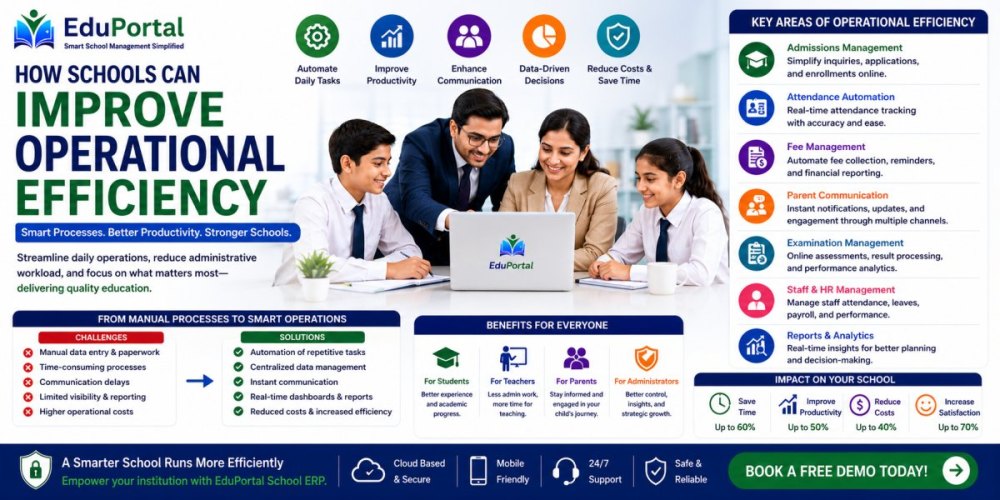
When comparing School ERP vs Manual Management, School ERP systems clearly offer greater efficiency, accuracy, scalability, and transparency. While manual administration relies on paper records, spreadsheets, and repetitive tasks, a School ERP centralizes operations such as admissions, attendance, fee management, examinations, communication, and reporting into a single digital platform.
In 2026, schools face increasing demands from parents, regulators, and administrators. Managing operations manually often leads to inefficiencies, errors, delayed communication, and limited visibility into school performance. A School ERP automates routine processes, provides real-time data, improves parent engagement, and enables data-driven decision-making. For modern educational institutions seeking growth and operational excellence, School ERP systems have become the preferred choice.
Introduction
For decades, schools successfully managed operations using paper records, filing cabinets, registers, and spreadsheets.
These methods worked when schools were smaller, parent expectations were lower, and administrative requirements were less demanding.
However, education has changed dramatically.
Modern schools must manage:
-
Admissions
-
Student records
-
Attendance
-
Fee collection
-
Examinations
-
Parent communication
-
Staff management
-
Compliance reporting
At the same time, parents expect instant access to information, administrators need real-time reports, and educational institutions must operate more efficiently than ever.
This has created a fundamental question for school owners and principals:
Should schools continue using manual administration methods or invest in a School ERP system?
The answer can significantly impact operational efficiency, parent satisfaction, staff productivity, and long-term growth.
This guide compares School ERP vs Manual Management and helps educational leaders determine the best approach for 2026 and beyond.
Why This Topic Matters in 2026
Educational institutions are experiencing rapid digital transformation.
Several trends are making School ERP adoption increasingly important.
Growing Student Populations
Schools are managing more students and more data than ever before.
Manual systems struggle to scale efficiently.
Rising Parent Expectations
Parents expect real-time updates regarding:
-
Attendance
-
Academic performance
-
Fee payments
-
School announcements
Demand for Operational Efficiency
Schools need to reduce administrative workload while maintaining service quality.
Data-Driven Decision Making
School leaders require accurate reports and analytics.
Increased Competition
Schools that provide modern digital experiences often attract and retain more families.
These factors make the School ERP vs Manual Management debate highly relevant in 2026.
What Is Manual School Administration?
Manual administration refers to managing school operations using traditional methods.
Common tools include:
-
Paper records
-
Registers
-
Filing cabinets
-
Spreadsheets
-
Physical forms
Examples
-
Attendance recorded in registers
-
Fee records maintained manually
-
Examination reports prepared by hand
-
Parent communication via printed notices
While familiar, these methods often become inefficient as schools grow.
What Is a School ERP?
A School ERP (Enterprise Resource Planning) system is a centralized software platform designed to automate and manage school operations.
A modern School ERP integrates:
-
Admissions
-
Student records
-
Attendance
-
Fees
-
Examinations
-
Parent communication
-
Reporting
-
Staff management
Everything is managed through a single system.
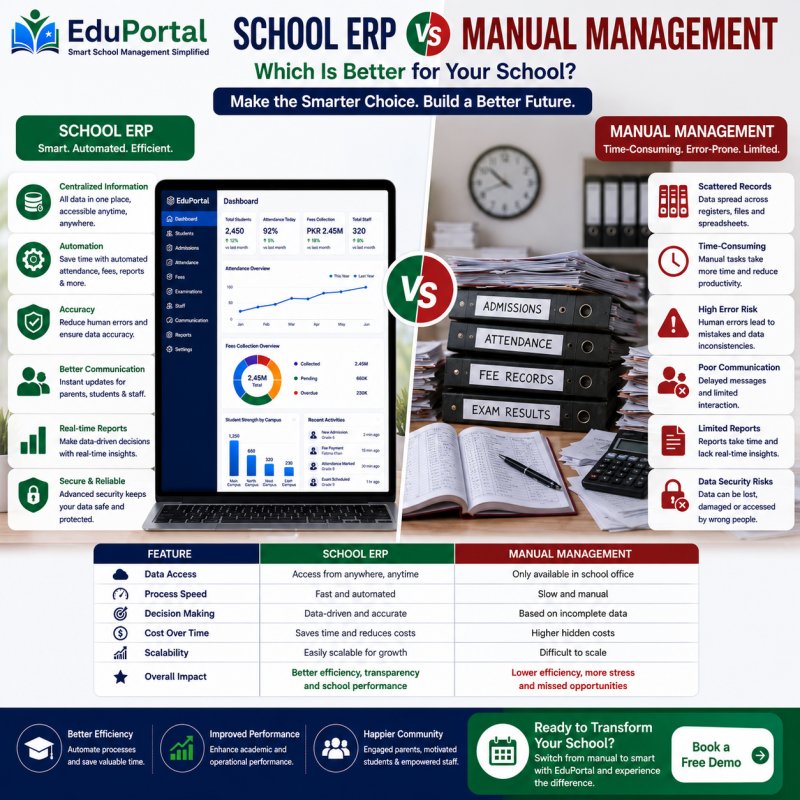
School ERP vs Manual Management: Complete Comparison
| Area | Manual Management | School ERP |
|---|---|---|
| Data Storage | Paper Files & Spreadsheets | Centralized Database |
| Attendance | Manual Registers | Automated Tracking |
| Fee Collection | Manual Monitoring | Automated Management |
| Reporting | Time-Consuming | Instant Reports |
| Communication | Phone Calls & Notices | Real-Time Notifications |
| Data Accuracy | Higher Error Risk | Improved Accuracy |
| Accessibility | Office-Based | Anywhere Access |
| Scalability | Limited | Highly Scalable |
| Security | Physical Storage Risks | Digital Security Controls |
| Decision Making | Historical Data | Real-Time Insights |
The difference becomes more significant as institutions expand.
Key Advantages of School ERP Over Manual Management
Improved Efficiency
Manual processes require repetitive work.
School ERP systems automate routine tasks.
Examples
-
Attendance recording
-
Fee reminders
-
Report generation
-
Admissions tracking
This allows staff to focus on higher-value activities.
Better Data Accuracy
Human errors are common in manual systems.
School ERP platforms reduce mistakes through automation and centralized records.
Real-Time Access to Information
Administrators can access important information instantly.
Examples include:
-
Fee collection status
-
Student attendance
-
Academic performance
-
Enrollment data
Enhanced Parent Communication
Modern parents expect transparency.
School ERP systems provide:
-
Mobile apps
-
SMS alerts
-
Push notifications
-
Parent portals
This improves engagement and trust.
Faster Reporting
Manual reporting often requires hours of data compilation.
School ERP systems generate reports instantly.
Common Reports
-
Attendance reports
-
Fee collection summaries
-
Examination analysis
-
Enrollment statistics
Better Financial Management
ERP systems simplify:
-
Fee collection
-
Outstanding fee tracking
-
Revenue reporting
-
Financial oversight
Schools gain greater visibility into finances.
Scalability for Growth
As student numbers increase, manual systems become harder to manage.
ERP systems scale easily with institutional growth.
Situations Where Manual Administration Creates Challenges
Managing Large Student Populations
Thousands of records become difficult to manage manually.
Multiple Campus Operations
Centralized visibility becomes almost impossible without technology.
Frequent Reporting Requirements
Manual reporting consumes valuable administrative time.
High Parent Communication Demands
Parents increasingly expect instant updates.
Complex Fee Structures
Manual fee tracking increases the risk of errors and delays.
Real School Scenario
A school with approximately 3,000 students relied heavily on manual administration.
Challenges
-
Attendance registers required daily processing
-
Fee collection tracking was inconsistent
-
Reporting consumed significant staff time
-
Parent communication was delayed
Solution
The school implemented a School ERP platform.
Results After One Academic Year
-
Administrative workload decreased substantially
-
Fee collection visibility improved
-
Parent engagement increased
-
Reporting became faster and more accurate
-
Leadership gained real-time operational insights
The institution reported improved efficiency across multiple departments.
Hidden Costs of Manual Management
Many schools assume manual systems are less expensive.
However, hidden costs often include:
Staff Time
Manual processes require more labor.
Errors
Mistakes create additional work and financial losses.
Delayed Decisions
Lack of real-time information affects strategic planning.
Poor Parent Experience
Communication gaps may impact school reputation.
Growth Limitations
Manual systems often restrict scalability.
These costs frequently exceed the investment required for a modern ERP system.
Common Mistakes Schools Make
Delaying Digital Transformation
Waiting too long often increases operational challenges.
Assuming Manual Systems Are Cheaper
Hidden inefficiencies often outweigh perceived savings.
Using Multiple Disconnected Tools
Separate systems create data silos and duplicate work.
Ignoring Parent Expectations
Modern families increasingly expect digital services.
Focusing Only on Short-Term Costs
Schools should evaluate long-term value and efficiency.
Expert Recommendation
Small Schools
Start with:
-
Admissions management
-
Attendance tracking
-
Parent communication
Medium-Sized Schools
Add:
-
Fee management
-
Examination modules
-
Reporting dashboards
Large Educational Institutions
Implement:
-
Full School ERP platforms
-
Multi-campus management
-
Advanced analytics
-
Enterprise security
The most successful schools view ERP implementation as a strategic investment rather than a software purchase.
How EduPortal Solves This Problem
EduPortal is designed to help schools transition from manual administration to intelligent automation.
Admissions Automation
Digitize inquiries, applications, and enrollment workflows.
Smart Attendance Management
Replace manual registers with real-time tracking.
Advanced Fee Management
Monitor collections, outstanding balances, and financial performance.
Parent Communication Platform
Improve engagement through instant notifications and mobile access.
Reporting & Analytics
Generate actionable insights through centralized dashboards.
Multi-Campus Management
Manage multiple branches from a single platform.
Cloud-Based Accessibility
Access school information securely from anywhere.
Integrated School Operations
Connect admissions, attendance, fees, examinations, and communication into one unified system.
EduPortal empowers schools to operate more efficiently, make better decisions, and deliver superior experiences to parents and students.
Frequently Asked Questions
1. What is the difference between School ERP and Manual Management?
Manual Management relies on paper records and spreadsheets, while School ERP automates and centralizes operations.
2. Is School ERP better than manual administration?
For most modern schools, yes. ERP systems improve efficiency, accuracy, and scalability.
3. Are manual systems still suitable for small schools?
Small schools can operate manually, but automation often improves efficiency significantly.
4. Does School ERP reduce administrative workload?
Yes. Automation eliminates many repetitive tasks.
5. Can School ERP improve parent communication?
Absolutely. ERP systems provide real-time updates and digital communication channels.
6. How does ERP improve attendance management?
Attendance tracking becomes faster, more accurate, and easier to monitor.
7. Can School ERP reduce errors?
Yes. Automation minimizes manual data entry mistakes.
8. Is School ERP expensive?
Costs vary, but many schools recover the investment through efficiency gains.
9. How does ERP support school growth?
ERP systems scale easily as student populations increase.
10. What reports can ERP systems generate?
Attendance, fees, examinations, admissions, and performance reports.
11. Is cloud-based ERP secure?
Modern ERP platforms include advanced security measures and backups.
12. How long does ERP implementation take?
Implementation timelines vary based on school size and requirements.
13. Can ERP replace spreadsheets?
Yes. Most ERP systems eliminate the need for multiple spreadsheets.
14. What are the risks of manual management?
Errors, inefficiency, delayed reporting, and scalability challenges.
15. Why choose EduPortal?
EduPortal provides a complete School ERP solution that automates operations and improves school performance.
Conclusion
The comparison between School ERP vs Manual Management is no longer simply a technology discussion—it is a strategic decision that affects every aspect of school operations.
While manual administration may seem familiar and inexpensive, it often creates hidden inefficiencies, communication challenges, and scalability limitations. Modern School ERP systems provide automation, transparency, real-time visibility, and operational control that manual methods simply cannot match.
As schools continue evolving in 2026, institutions that embrace digital transformation will be better equipped to serve students, engage parents, support staff, and achieve sustainable growth.
Ready to Move Beyond Manual Administration?
Discover how EduPortal can help your institution automate operations, improve efficiency, and transform school management through a powerful all-in-one School ERP solution.
Book an EduPortal demo today and experience the future of school management.