Why Modern Schools Need a Cloud-Based ERP System in 2026
Quick Answer
A Cloud School ERP is a centralized, internet-based school management platform that helps educational institutions manage admissions, attendance, fee collection, examinations, communication, staff records, and reporting from a single system. Unlike traditional on-premise software, a Cloud School ERP allows school leaders, teachers, parents, and administrators to access information securely from anywhere, at any time.
In 2026, schools are expected to operate faster, communicate better, and make data-driven decisions. Manual processes and disconnected systems can no longer keep up with growing administrative demands. A Cloud School ERP improves efficiency, reduces paperwork, enhances parent engagement, strengthens data security, and provides real-time visibility into school operations. For modern schools looking to scale, improve service quality, and remain competitive, adopting a Cloud School ERP is no longer optional—it is a strategic necessity.
Introduction
The education sector has changed dramatically over the last decade. Schools are no longer judged solely on academic performance; parents now expect transparency, instant communication, digital accessibility, and efficient administration. At the same time, school owners and administrators face increasing pressure to manage larger student populations, multiple campuses, compliance requirements, and operational costs.
Yet many schools still rely on spreadsheets, paper files, standalone software, and manual processes. These outdated methods create inefficiencies, increase the risk of errors, and consume valuable staff time.
This is where a Cloud School ERP becomes essential.
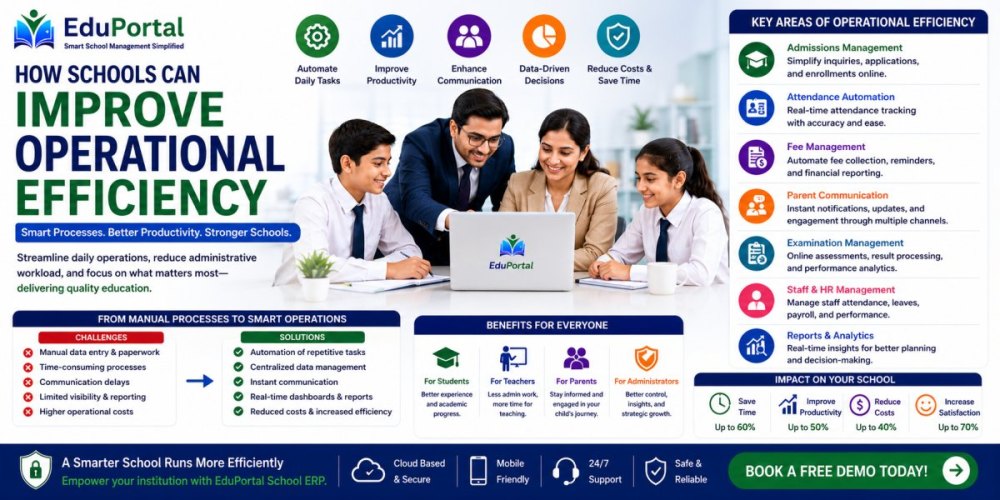
A cloud-based school management system enables schools to automate routine administrative tasks, centralize data, improve communication, and make smarter decisions using real-time information. Whether you manage a private school, public institution, college, or educational network, cloud technology can transform how your institution operates.
In this guide, we'll explore why modern schools need a Cloud School ERP in 2026, the benefits it delivers, common implementation mistakes, and how EduPortal helps educational institutions thrive in a digital-first world.
What Is a Cloud School ERP?
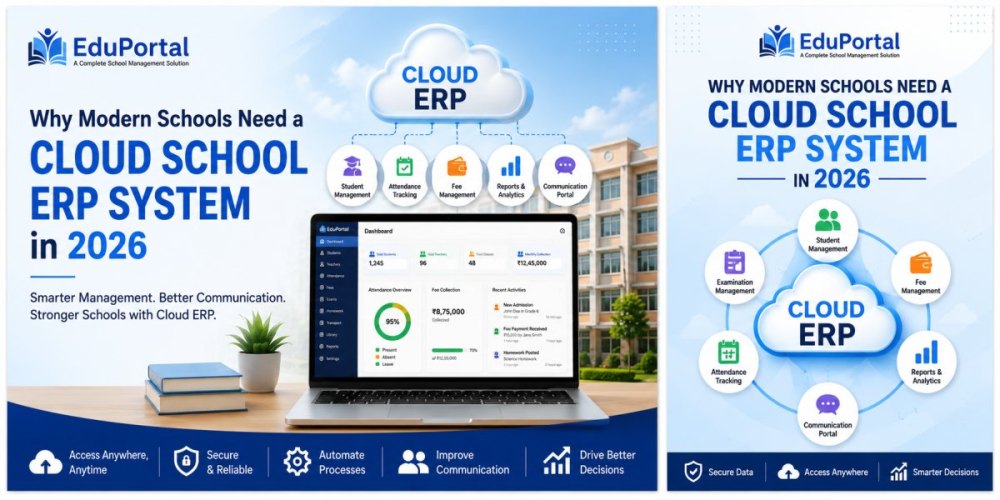
A Cloud School ERP (Enterprise Resource Planning) system is a web-based platform that integrates all major school functions into a single centralized solution.
Instead of storing information on local computers or servers, data is securely stored in the cloud and can be accessed through the internet.
A Cloud School ERP typically manages:
-
Student admissions
-
Attendance tracking
-
Fee collection
-
Examination management
-
Academic records
-
Parent communication
-
Staff management
-
Payroll
-
Timetable scheduling
-
Transport management
-
Reporting and analytics
The primary goal is to eliminate operational silos and create a connected ecosystem where information flows seamlessly across departments.
Traditional ERP vs Cloud School ERP
Traditional school systems often require expensive infrastructure, ongoing maintenance, and physical access to school servers.
Cloud-based systems offer:
-
Remote access
-
Automatic updates
-
Lower IT costs
-
Better scalability
-
Improved security
-
Faster deployment
As educational institutions embrace digital transformation, cloud ERP solutions have become the preferred choice.
Why This Matters in 2026
Schools in 2026 face challenges that did not exist a decade ago.
Rising Parent Expectations
Parents expect instant updates regarding:
-
Attendance
-
Examination results
-
Fee payments
-
School announcements
-
Academic progress
They want information available through mobile devices whenever they need it.
Multi-Campus Growth
Many educational groups now operate multiple branches.
Managing operations through disconnected systems creates confusion and inconsistencies.
Data-Driven Decision Making
School leaders need access to accurate information to make strategic decisions about:
-
Admissions growth
-
Staff allocation
-
Financial planning
-
Academic performance
Mobile-First Communication
Today's parents and staff rely heavily on smartphones. Schools need platforms that support real-time mobile communication.
Increased Focus on Security
Student and staff information must be protected through secure digital infrastructure.
Cloud ERP systems provide stronger security controls than many traditional setups.
Traditional School Management vs Cloud School ERP
| Feature | Traditional System | Cloud School ERP |
|---|---|---|
| Data Access | Limited to school premises | Access from anywhere |
| Security | Depends on local infrastructure | Enterprise-grade cloud security |
| Updates | Manual updates required | Automatic updates |
| Reporting | Time-consuming | Real-time reports |
| Parent Communication | Phone calls and notices | Instant notifications |
| Maintenance | High IT costs | Minimal maintenance |
| Scalability | Limited | Highly scalable |
| Multi-Campus Support | Difficult | Built-in support |
| Backup & Recovery | Risk of data loss | Automated backups |
| Cost Efficiency | High long-term cost | Lower total cost of ownership |
The difference becomes increasingly significant as schools grow and operational complexity increases.
Top Benefits of a Cloud School ERP
Anywhere, Anytime Access
School leaders can access important information from any location.
Whether attending meetings, traveling between campuses, or working remotely, administrators remain connected to school operations.
Example
A principal attending an education conference can instantly review attendance reports, fee collection summaries, and staff updates through a mobile device.
Centralized School Data
All departments work from a single source of truth.
This eliminates duplicate records, inconsistent information, and communication gaps.
Example
Admissions, finance, academics, and administration can all access the same student record without maintaining separate databases.
Better Parent Communication
Effective communication builds trust.
Cloud ERP systems provide direct communication channels between schools and families.
Benefits
-
Instant notifications
-
Attendance alerts
-
Examination updates
-
Fee reminders
-
Event announcements
Automated Attendance Management
Manual attendance tracking consumes valuable time and often leads to errors.
Cloud ERP systems automate attendance processes and provide real-time visibility.
Benefits
-
Faster attendance recording
-
Automated reports
-
Parent notifications
-
Improved accuracy
Faster Fee Collection
Fee management is one of the most critical administrative functions.
Automation improves collection efficiency and reduces financial leakage.
Benefits
-
Automated invoicing
-
Payment tracking
-
Fee reminders
-
Financial reporting
Real-Time Reporting
School leaders no longer need to wait days for reports.
Cloud ERP platforms generate insights instantly.
Examples
-
Enrollment trends
-
Attendance analysis
-
Revenue reports
-
Academic performance dashboards
Improved Decision Making
Reliable data enables better strategic planning.
Administrators can identify challenges early and make informed decisions based on evidence rather than assumptions.
Reduced Administrative Workload
Automation removes repetitive tasks from daily operations.
Staff can focus on higher-value activities instead of paperwork.
Better Data Security
Cloud platforms invest heavily in cybersecurity.
Features often include:
-
Data encryption
-
Role-based access
-
Secure backups
-
Activity monitoring
Easy Scalability
As schools grow, cloud systems can expand without requiring major infrastructure investments.
This is particularly important for educational groups planning future expansion.
Real School Scenario
A private school with approximately 1,500 students was managing operations using spreadsheets and several disconnected software applications.
Challenges
-
Delayed fee tracking
-
Inaccurate attendance records
-
Communication gaps with parents
-
Time-consuming report generation
-
Difficulty managing growing enrollment
Solution
The school implemented a Cloud School ERP to centralize operations.
Results After Six Months
-
Administrative workload reduced significantly
-
Attendance reporting became real-time
-
Parent engagement increased through mobile notifications
-
Fee collection efficiency improved
-
Management gained access to instant reports
The school leadership reported better operational visibility and faster decision-making across departments.
Hidden Costs of Not Using a Cloud ERP
Many schools underestimate the cost of outdated systems.
Administrative Inefficiencies
Staff spend countless hours performing tasks that could be automated.
Human Errors
Manual data entry increases the likelihood of mistakes.
Revenue Leakage
Poor fee tracking can lead to missed collections.
Lost Productivity
Teachers and administrators spend time on paperwork instead of educational activities.
Parent Dissatisfaction
Slow communication can damage trust and engagement.
Delayed Decision Making
Without real-time data, school leaders often make decisions based on incomplete information.
Common Mistakes Schools Make
Choosing Software Based Only on Price
Low-cost solutions may lack critical functionality, support, and scalability.
Schools should focus on long-term value rather than initial cost.
Ignoring Data Migration Planning
Moving data from old systems requires careful preparation.
Poor migration planning can lead to data loss and operational disruptions.
Lack of Staff Training
Technology adoption depends on user confidence.
Comprehensive training is essential for successful implementation.
Using Multiple Disconnected Systems
Separate tools create data silos and inefficiencies.
An integrated ERP platform delivers significantly greater value.
Not Considering Future Growth
Schools should choose solutions capable of supporting expansion and increasing enrollment.
Expert Recommendation
For Small Schools
Choose a Cloud School ERP with core features:
-
Admissions
-
Attendance
-
Fee management
-
Parent communication
Focus on ease of use and affordability.
For Medium-Sized Schools
Prioritize:
-
Reporting tools
-
Examination management
-
Staff management
-
Mobile accessibility
For Large School Networks
Invest in solutions that offer:
-
Multi-campus management
-
Advanced analytics
-
Role-based access controls
-
Enterprise-level security
The ideal ERP should support both current requirements and future growth plans.
How EduPortal Solves This Problem
EduPortal is designed specifically for modern educational institutions seeking operational excellence through digital transformation.
Cloud-Based Access
Access school data securely from anywhere, at any time.
Student Information Management
Maintain comprehensive student records within a centralized platform.
Smart Attendance Tracking
Monitor attendance efficiently and generate real-time reports.
Automated Fee Management
Track payments, generate invoices, and improve collection efficiency.
Parent Communication Tools
Strengthen parent engagement through instant notifications and updates.
Examination Management
Simplify exam scheduling, grading, and result generation.
Advanced Reporting & Analytics
Access actionable insights through dashboards and detailed reports.
Multi-Campus Management
Manage multiple branches from a single centralized system.
Data Security & Reliability
Protect sensitive information through secure cloud infrastructure and automated backups.
EduPortal enables schools to automate operations, improve efficiency, and deliver a superior educational experience.
Frequently Asked Questions
1. What is a Cloud School ERP?
A Cloud School ERP is an internet-based school management system that centralizes administrative and academic operations.
2. How is a Cloud ERP different from traditional ERP?
Cloud ERP is hosted online, enabling remote access, automatic updates, and easier scalability.
3. Is cloud-based school software secure?
Yes. Modern cloud solutions typically include encryption, backups, and advanced security controls.
4. Can small schools benefit from a Cloud School ERP?
Absolutely. Even small institutions can improve efficiency through automation.
5. Does Cloud ERP support multiple campuses?
Yes. Most modern solutions support centralized management of multiple branches.
6. How does ERP improve fee collection?
It automates invoicing, payment tracking, reminders, and financial reporting.
7. Can parents access information online?
Yes. Parent portals and mobile applications provide real-time access to school information.
8. Does ERP reduce paperwork?
Significantly. Many administrative processes become fully digital.
9. How long does implementation take?
Implementation timelines vary based on school size and complexity.
10. What features should a school ERP include?
Admissions, attendance, fees, examinations, communication, reporting, and staff management.
11. Can ERP improve attendance management?
Yes. Attendance recording becomes faster, more accurate, and easier to analyze.
12. Does cloud ERP support mobile devices?
Yes. Most modern systems are mobile-friendly.
13. Is Cloud ERP suitable for colleges?
Yes. Educational institutions of all sizes can benefit from ERP technology.
14. Can ERP improve parent satisfaction?
Yes. Better communication and transparency strengthen parent relationships.
15. Why choose EduPortal?
EduPortal offers a comprehensive, cloud-based platform designed specifically for modern educational institutions.
Conclusion
Education is becoming increasingly digital, data-driven, and connected. Schools that continue relying on manual processes risk falling behind in efficiency, communication, and service quality.
A Cloud School ERP helps educational institutions streamline operations, reduce administrative burdens, improve parent engagement, strengthen data security, and make informed decisions through real-time insights.
Whether you operate a single campus or a growing educational network, investing in the right ERP platform can create lasting operational and financial benefits.
Ready to Modernize Your School?
Discover how EduPortal can help your institution automate operations, improve efficiency, and deliver a better educational experience.
Book a free EduPortal demo today and experience the future of school management.